How to Write a Conclusion for a Personal Statement (With a 4-Step Framework)
Write a personal statement conclusion that ties your story together and looks ahead. Follow a four-step framework, see full example conclusions for college and graduate school, and avoid common mistakes.
You have written a personal statement that opens with a vivid moment and develops a real story. Then you reach the last paragraph and freeze. Do you summarize everything? Thank the committee? Announce how much you want to be admitted?
None of those, usually. The conclusion of a personal statement has a different job from the conclusion of an academic essay. You are not proving a thesis; you are leaving the reader with a clear picture of who you are and where you are going. This guide gives you a four-step framework for that final paragraph, full examples, and a list of mistakes to avoid.
What Makes a Personal Statement Conclusion Different
In a typical academic essay, the conclusion restates the thesis and explains its significance. In a personal statement, a strict summary feels mechanical, because the reader has just finished your story a few seconds ago.
Instead, a strong personal statement conclusion does three things:
- Connects the story you told to the person you have become.
- Points forward to what you want to do next.
- Lands on a final image or idea that feels like an ending, not just a stopping point.
Think of it as zooming out. The body of your statement is a close-up of experiences; the conclusion pulls the camera back to show what those experiences add up to.
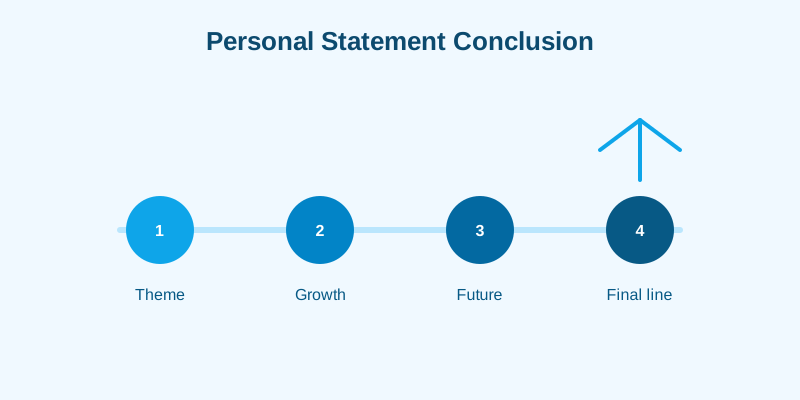
The 4-Step Conclusion Framework
You will not always need all four steps in this exact order, but this structure works for most personal statements, whether they are for undergraduate admission, graduate programs, scholarships, or professional schools.
Step 1: Return to Your Central Theme
Most strong personal statements are built around one theme: curiosity, resilience, responsibility, a love of building things, a commitment to a community. Name or echo that theme in your first sentence, ideally with fresh wording.
Looking back, the hours I spent fixing broken radios were never really about radios. They were about refusing to accept that something was beyond repair.
Step 2: Show What Changed
Admissions readers want to see growth. In one or two sentences, explain how you think or act differently because of the experiences you described.
I still get frustrated when a circuit fails, but I now treat the failure as information instead of a verdict.
This is where your statement turns from a story into evidence of character.
Step 3: Look Ahead
Connect who you are now to what you want to do next. Be concrete enough to sound real, but avoid an itemized list of courses (save that for supplemental essays).
In college, I want to study electrical engineering so that I can design devices that are easier to repair, not harder, and I want to keep teaching younger students in my neighborhood how to open things up and look inside.
For graduate or professional programs, this step can name a research interest, a population you hope to serve, or the kind of professional you aim to become.
Step 4: End With a Resonant Final Line
Finish with a sentence that feels complete. Strong options include returning to an image from your opening, a short forward-looking statement, or a simple line that captures your theme. (We cover these in depth in our guide on how to end a personal statement.)
There will always be something broken on my workbench. I hope there always is.
Full Example: Undergraduate Personal Statement
This example is an original sample written for this guide. Imagine the statement opened with the writer translating for their parents at a bank, and the body described becoming the family’s informal advocate for forms, phone calls, and appointments.
I used to think of translating as a chore, the reason I missed weekend plans and spent afternoons on hold. Somewhere between the bank, the clinic, and the school office, it became something else: proof that I could make complicated systems understandable to the people they were supposed to serve. That idea now shapes what I want to study. I hope to major in public policy and learn how forms, laws, and services are designed, so that one day fewer families will need a fourteen-year-old to explain them. Until then, my phone will keep ringing, and I will keep answering it.
What it does well:
- Echoes the theme (translation, advocacy) without repeating earlier sentences.
- Shows a change in perspective (“a chore” became “proof”).
- States a direction (public policy) linked directly to the story.
- Ends on a simple image that echoes the opening.
Full Example: Graduate School Statement
Graduate statements are often more professional in tone, and the conclusion usually emphasizes research fit and readiness. This is also an original sample.
My time coordinating the reading program taught me that a single intervention rarely works the same way twice; context matters more than the curriculum itself. I want to study that problem rigorously. A master’s program in education policy would give me the quantitative training to evaluate programs like ours and the theoretical grounding to explain why they succeed or fail in different settings. I am ready to move from running programs to understanding them, and to bring what I learn back to the classrooms that taught me to ask these questions.
What it does well: it connects experience to a research question, explains why the program is the next logical step, and ends with a clear statement of purpose.
How Long Should the Conclusion Be?
For a 650-word college personal statement, a conclusion of roughly 60 to 120 words (one short paragraph) is usually enough. Graduate statements that run 800 to 1,000 words can support a slightly longer final paragraph. If your conclusion is as long as a body paragraph, you are probably repeating content or adding new material.
Common Mistakes to Avoid
- Summarizing your whole essay. “In conclusion, through debate, volunteering, and my job, I have learned many things.” The reader already knows.
- Introducing a brand-new story. A new anecdote in the final paragraph leaves the reader wondering why it was not in the body.
- Begging or thanking. “I would be honored to be admitted” or “Thank you for considering my application” wastes your final words.
- Overpromising. “I will cure cancer” sounds less credible than a specific, realistic goal.
- Generic lessons. “This taught me to never give up” could end thousands of essays. Make the lesson specific to your experience.
- Starting with “In conclusion.” Personal statements are closer to storytelling than to formal argument; a signpost phrase sounds stiff.
- Changing tone. If the essay is warm and reflective, a sudden formal ending feels like a different writer.
Quick Fix: Turning a Weak Conclusion Into a Strong One
Weak:
In conclusion, my experiences have taught me the importance of hard work and perseverance. I believe these qualities will make me a great addition to your university, and I hope you will give me the opportunity to attend.
Strong:
I still have the notebook where I tracked every practice score that first season, most of them in red. Those numbers taught me that improvement is slow and rarely dramatic, and that I am willing to keep showing up anyway. I want to bring that patience to the study of biology, a field where most experiments fail before one finally works. I already know how to fill a notebook with red ink. I am ready to find out what comes after it.
The strong version uses a concrete image, states a specific change, links to an academic direction, and closes with a line that echoes the opening.
Personal Statement Conclusion Checklist
- Does my conclusion return to the central theme of my statement?
- Have I shown what changed in me, not just what happened?
- Is there a clear forward-looking direction?
- Does it avoid summarizing every paragraph?
- Have I avoided new stories, thank-yous, and clichés?
- Does the last line feel like an ending?
- Is it short enough to stay within the word limit?
Practice Exercise
Reread your personal statement and underline the single image or moment you remember most. Now write three different final sentences that refer back to it: one reflective, one forward-looking, and one that simply describes the image again with new meaning. Read each one aloud after your full essay and keep the version that makes the statement feel finished.
For broader guidance on closing any essay, see how to write a conclusion that leaves a lasting impression, and polish your final draft with our three-pass editing system.
Frequently Asked Questions
Should a personal statement have a conclusion?
How long should a personal statement conclusion be?
Should I summarize my personal statement in the conclusion?
Should I thank the admissions committee at the end?
Keep Learning
How to End a Personal Statement: 7 Final-Line Techniques (With Examples)
Struggling with the last line of your personal statement? Learn seven techniques for ending a personal statement memorably, with examples for each, the endings admissions readers see too often, and a final-sentence test.
College AdmissionsHow to Start a Why Us Essay: 6 Openings Admissions Readers Remember
Learn how to start a Why Us college essay with a specific, personal opening. Includes six proven opening strategies, before-and-after examples, and the first lines to avoid.
RhetoricHow to Write a Conclusion for a Rhetorical Analysis Essay (Step-by-Step + Example)
Learn how to write a rhetorical analysis conclusion that goes beyond summary. Follow a four-part structure, use sentence starters, see a full example, and get tips for AP Language timed essays.