 Javed Ali • • 7 min read • Essay Writing
How to Write a Rhetorical Analysis Essay: Step-by-Step Guide With Example
Learn how to write a rhetorical analysis essay step by step: read for the rhetorical situation, find the writer's choices, build a thesis, and analyze with SPACE and SOAPSTone. Includes an annotated example paragraph on the Gettysburg Address.
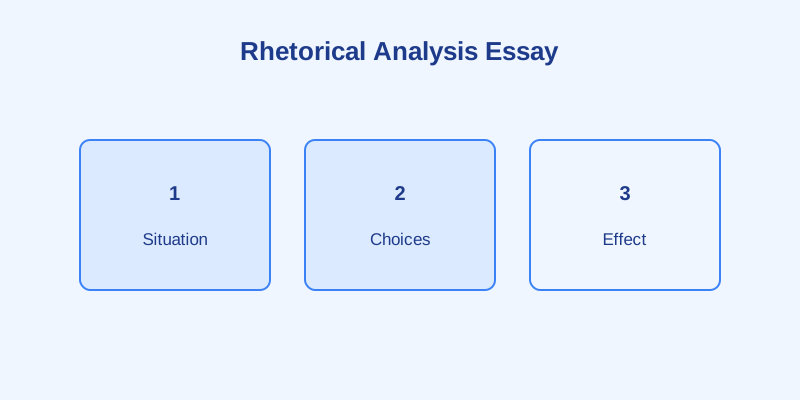
A rhetorical analysis essay asks a different question from most essays you write. You aren’t deciding whether the author is right. You’re explaining how the author tries to persuade, inform, or move a particular audience, and whether those techniques work.
That shift trips up many students. They summarize the text, or they argue with it, or they list “ethos, pathos, logos” without saying anything about them. This guide shows you how to avoid all three mistakes, using a step-by-step method and a worked example on Abraham Lincoln’s Gettysburg Address.
What Is a Rhetorical Analysis?
A rhetorical analysis examines the choices a writer or speaker makes to achieve a purpose with a specific audience. Those choices can include:
- Appeals: to credibility (ethos), emotion (pathos), or logic (logos)
- Structure: how the text is ordered and where it shifts
- Diction: specific word choices and their connotations
- Syntax: sentence length, repetition, parallelism
- Imagery and figurative language: metaphors, analogies, vivid detail
- Tone: the author’s attitude, and how it changes
The texts you analyze can be speeches, op-eds, letters, advertisements, or essays. In the AP English Language exam, the rhetorical analysis question gives you a short passage and about 40 minutes to write. In a class assignment, you might have a week and a longer text. The method is the same.
Step 1: Understand the Rhetorical Situation
Before you can analyze choices, you need to know what problem the author was trying to solve. Two common acronyms help.
SOAPSTone:
| Letter | Question |
|---|---|
| Speaker | Who is writing or speaking, and what gives them authority? |
| Occasion | What event or context prompted the text? |
| Audience | Who is it for, and what do they already believe? |
| Purpose | What does the author want the audience to think, feel, or do? |
| Subject | What is the text about? |
| Tone | What is the author’s attitude? |
SPACE (a shorter version): Speaker, Purpose, Audience, Context, Exigence. Exigence is the urgent issue or event that made the text necessary.
Applied to the Gettysburg Address:
- Speaker: President Lincoln, in the middle of the Civil War
- Occasion/Exigence: the dedication of a national cemetery in November 1863, months after one of the war’s bloodiest battles
- Audience: the crowd at Gettysburg, many grieving, and the wider Union public who would read the speech in newspapers
- Purpose: to honor the dead and to persuade the living to keep fighting
- Tone: solemn, then resolute
Notice that the purpose has two parts. Spotting tension like this, between what the occasion expects (mourning) and what the speaker actually wants (resolve), often gives you the most interesting thesis.
Step 2: Read for Choices, Not Content
On your second read, annotate what the author does, not what the author says. In the margin, write verbs: contrasts, repeats, shifts, concedes, praises, warns, narrows, flatters.
A quick way to find important choices:
- Look for shifts. Where does the tone, pronoun, or time frame change? Shifts usually mark a move in the argument.
- Look for repetition. Repeated words, phrases, or structures signal what the author wants to stick.
- Look at the first and last lines. Openings and closings are where authors invest the most effort.
- Ask “why this word, not another?” If Lincoln had written “eighty-seven years ago” instead of “four score and seven years ago,” what would be lost?
For the Gettysburg Address, you’d notice: the speech moves from the past (“our fathers brought forth”) to the present (“we are engaged”) to the future (“that this nation… shall have a new birth of freedom”). You’d notice the repetition of “we can not dedicate—we can not consecrate—we can not hallow.” And you’d notice the pronoun “we” throughout, which places Lincoln alongside the audience rather than above it.
Step 3: Write a Thesis About Strategy and Effect
A rhetorical analysis thesis should answer: What does the author do, and what does it accomplish with this audience?
- Weak: Lincoln uses ethos, pathos, and logos in the Gettysburg Address. (Every text uses appeals. This says nothing specific.)
- Weak: The Gettysburg Address is a great speech about the Civil War. (This is an opinion about the text, not an analysis of its choices.)
- Strong: Lincoln turns a cemetery dedication into a call to action by moving his audience from the nation’s founding to its uncertain future, and by repeating that the living cannot dedicate the ground, only the work that remains.
The strong thesis names specific choices (time structure, repetition), the purpose (a call to action), and the effect on the audience (redirecting grief toward resolve). It also gives you a plan for the body paragraphs.
For more on building claims like this, see our guide on how to write a thesis statement.
Step 4: Organize Your Body Paragraphs
You have two good options:
Organize by choice. Each paragraph analyzes one strategy (e.g. structure, repetition, pronouns). This is clear and works well for short texts.
Organize chronologically. Move through the text from beginning to end, explaining how each section builds on the last. This works well when the author’s argument develops in stages, and it naturally shows shifts. Many high-scoring AP essays use this approach.
Whichever you choose, avoid organizing by ethos, then pathos, then logos. It usually produces three disconnected lists instead of an argument about how the text works.
Step 5: Analyze, Don’t Summarize
Each body paragraph should follow a pattern like this:
- Claim: name the choice and its purpose
- Evidence: quote a short, precise piece of the text
- Analysis: explain how that choice affects the audience, and why it suits the situation
- Link: connect back to the author’s overall purpose
The analysis step is the heart of the essay. Useful verbs include emphasizes, reframes, invites, undercuts, reassures, implicates, elevates. Avoid empty phrases like “this shows” or “this makes the reader feel emotion.”
Annotated example body paragraph
(Claim) Lincoln first establishes a shared national identity by grounding the present war in the nation’s founding. (Evidence) He opens not with the battle but with history: “Four score and seven years ago our fathers brought forth on this continent, a new nation, conceived in Liberty, and dedicated to the proposition that all men are created equal.” (Analysis) The biblical cadence of “four score and seven” lends the moment a solemn, almost scriptural weight, appropriate to a cemetery. More importantly, by calling the founders “our fathers,” Lincoln makes everyone in the crowd an heir to the same family. The war is no longer a distant political conflict; it is a test of an inheritance the audience personally owns. Choosing the Declaration’s phrase “all men are created equal,” rather than the Constitution, also quietly frames the war around equality. (Link) This sense of shared inheritance prepares the audience for the speech’s final turn, where Lincoln asks them to protect what their “fathers” began.
Notice how much of the paragraph is analysis. The quotation is one sentence; the explanation is four.
Step 6: Write the Introduction and Conclusion
Introduction: Briefly set up the rhetorical situation (speaker, occasion, audience, purpose) in two or three sentences, then give your thesis. You don’t need a dramatic hook; precise context is more valuable here.
In November 1863, Abraham Lincoln was invited to say “a few appropriate remarks” at the dedication of a military cemetery in Gettysburg, Pennsylvania. His audience expected words of mourning. Instead, in fewer than three hundred words, Lincoln turned a cemetery dedication into a call to action by moving his audience from the nation’s founding to its uncertain future, and by repeating that the living cannot dedicate the ground, only the work that remains.
Conclusion: Don’t just restate. Explain why the author’s strategy matters: what it reveals about persuasion, the moment, or the audience. Our guide on how to write a conclusion for a rhetorical analysis essay covers this in depth.
Common Mistakes
- Summarizing the text. If a paragraph could be written by someone who only read a summary, it isn’t analysis.
- Arguing with the author. Whether you agree with the argument doesn’t matter. Your task is to explain how it works.
- Device-spotting. “Lincoln uses anaphora” is an observation, not analysis. Always explain the effect on this audience. Our list of rhetorical devices with examples helps you name devices; your job is to go further.
- Vague effects. “This makes the audience feel emotional” is too general. Which emotion? Why does the author want it at that moment?
- Long quotations. Quote a phrase or a sentence, not a paragraph. Short quotes keep the focus on your analysis.
- Ignoring the audience. Every claim should connect the choice to the specific people the author was addressing.
Rhetorical Analysis Checklist
- Have I identified the speaker, audience, purpose, and context?
- Does my thesis name specific choices and what they accomplish?
- Are my body paragraphs organized by choice or by the text’s progression, not by “ethos/pathos/logos”?
- Does each paragraph explain how a choice affects the audience?
- Is most of each paragraph my analysis rather than quotation or summary?
- Have I used precise verbs (emphasizes, reframes, invites) instead of “shows”?
- Does my conclusion explain why the strategy matters?
Practice Exercise
Find a short persuasive text: a one-page op-ed, a commencement speech excerpt, or a print advertisement. First, fill in a SOAPSTone table. Then mark every shift in tone, pronoun, or time frame. Choose the two most important shifts and write one sentence for each completing this frame: “By [specific choice], the author [effect] in order to [purpose] for [audience].” Combine those two sentences into a thesis, and you have the skeleton of a full rhetorical analysis. When your draft is finished, use our guide to proofreading and editing your essay to tighten it.
Frequently Asked Questions
What is a rhetorical analysis essay?
What should a rhetorical analysis thesis include?
How do you structure a rhetorical analysis essay?
Do I need to use ethos, pathos, and logos?
Keep Learning
How to Write an Expository Essay: Types, Structure, and Example
Learn how to write an expository essay that explains a topic clearly and objectively. Covers the five main types, a thesis formula, body paragraph structure, an example outline, common mistakes, and a checklist.
Essay WritingHow to Do a Literacy Essay: Write a Literacy Narrative Readers Connect With
A step-by-step guide to writing a literacy essay (literacy narrative): choosing a meaningful moment, structuring your story, reflecting on what it means, plus an original example and topic ideas.
Essay WritingWhat Is a Great Thesis Statement? 7 Tests That Separate Good From Great
What makes a thesis statement great, not just correct? Use seven simple tests to evaluate and upgrade your thesis, with before-and-after examples showing how average claims become memorable ones.