How to Cite Sources in MLA and APA Style: A Beginner's Guide
Learn when to cite, how in-text citations and reference lists work, and the MLA 9th edition and APA 7th edition formats for books, journal articles, and websites.
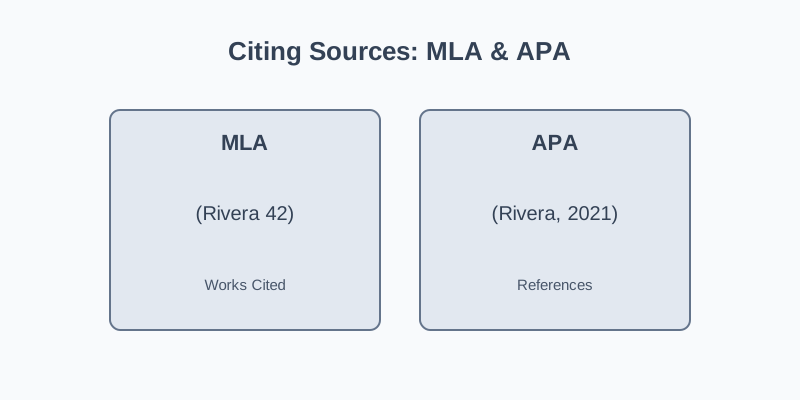
Citing sources can feel like a chore of commas, italics, and rules that seem to exist only to cost you marks. But citation does real work. It gives credit to the people whose ideas you used, shows your reader that your claims rest on evidence, and lets anyone follow your trail back to the original source. It also protects you from plagiarism.
This guide covers the two citation styles students meet most often: MLA (9th edition), common in English and the humanities, and APA (7th edition), common in psychology, education, and the social sciences. You’ll learn when to cite, how the two-part citation system works, and how to format the most common source types.
Always follow your instructor’s or institution’s requirements first. They may specify a particular edition or local variations. For full details, consult the official MLA Handbook and APA Publication Manual, or a trusted guide such as the Purdue Online Writing Lab.
When Do You Need to Cite?
Cite a source whenever you use:
- A direct quotation: someone else’s exact words
- A paraphrase: someone else’s idea, rewritten in your own words
- A summary: a condensed version of someone else’s argument
- Specific facts, statistics, or data that are not common knowledge
- Images, charts, or tables created by someone else
You generally don’t need to cite:
- Common knowledge: facts widely known and easily found in many general sources (e.g. “Paris is the capital of France” or “World War II ended in 1945”)
- Your own original ideas, analysis, and conclusions
When in doubt, cite. Over-citing is a minor style issue; under-citing can be treated as plagiarism.
How Citation Works: Two Parts
Both MLA and APA use a two-part system:
- In-text citations: brief references in the body of your essay, pointing to a source
- A list of full references at the end: called Works Cited in MLA and References in APA
Each in-text citation must match an entry in the list, and each entry in the list must be cited at least once in the text.
MLA Style (9th Edition)
MLA emphasizes authors and page numbers, reflecting the humanities’ focus on close reading of texts.
MLA in-text citations
Use the author’s last name and the page number, with no comma between them:
Early start times have been linked to lower attendance (Rivera 42).
If you name the author in your sentence, only the page number goes in parentheses:
Rivera argues that early start times reduce attendance (42).
- Two authors: (Rivera and Chen 42)
- Three or more authors: (Rivera et al. 42)
- No page numbers (e.g. websites): just the author (Rivera)
- No author: use a shortened title in quotation marks or italics (“Sleep and Learning”)
MLA Works Cited entries
MLA 9 builds every entry from a set of “core elements” in a fixed order: Author. Title of source. Title of container, Other contributors, Version, Number, Publisher, Publication date, Location.
The examples below use fictional sources for illustration.
Book:
Rivera, Ana. The Rested Mind: Sleep and Learning in Adolescence. Northfield Press, 2021.
Journal article:
Chen, Wei, and Laura Okafor. “School Start Times and Student Attendance.” Journal of Education Research, vol. 34, no. 2, 2022, pp. 115–31. https://doi.org/10.0000/example.2022.
Web page:
Patel, Sam. “Why Teenagers Can’t Fall Asleep Early.” Healthy Schools Network, 14 Mar. 2023, www.example.org/teen-sleep.
MLA formatting tips
- Title the page Works Cited, centered.
- List entries alphabetically by the author’s last name.
- Use a hanging indent (second and later lines indented 0.5 inch).
- Double-space the whole list.
- Italicize titles of whole works (books, journals, websites); put titles of parts (articles, chapters, web pages) in “quotation marks.”
- Use title case for titles (capitalize major words).
APA Style (7th Edition)
APA emphasizes authors and dates, reflecting the sciences’ concern with how recent research is.
APA in-text citations
Use the author’s last name and the year, separated by a comma:
Early start times have been linked to lower attendance (Rivera, 2021).
For direct quotations, add the page number:
Rivera (2021) described early start times as “a mismatch between school and biology” (p. 42).
- Two authors: (Chen & Okafor, 2022). Use ”&” in parentheses and “and” in running text.
- Three or more authors: (Smith et al., 2020) from the first citation
- No author: use the first few words of the title and the year
- No date: use “n.d.” (Patel, n.d.)
APA reference list entries
The examples below use fictional sources for illustration.
Book:
Rivera, A. (2021). The rested mind: Sleep and learning in adolescence. Northfield Press.
Journal article:
Chen, W., & Okafor, L. (2022). School start times and student attendance. Journal of Education Research, 34(2), 115–131. https://doi.org/10.0000/example.2022
Web page:
Patel, S. (2023, March 14). Why teenagers can’t fall asleep early. Healthy Schools Network. https://www.example.org/teen-sleep
APA formatting tips
- Title the page References, bold and centered.
- List entries alphabetically by the first author’s last name.
- Use a hanging indent and double-spacing.
- Use initials for authors’ first and middle names.
- Use sentence case for article and book titles (capitalize only the first word, the first word after a colon, and proper nouns).
- Italicize book titles, journal names, and journal volume numbers.
- Present DOIs as full URLs (https://doi.org/…).
MLA vs. APA at a Glance
| MLA (9th ed.) | APA (7th ed.) | |
|---|---|---|
| Common in | English, languages, humanities | Psychology, education, social sciences |
| In-text format | (Author page) | (Author, Year) |
| Example | (Rivera 42) | (Rivera, 2021) |
| Two authors | (Rivera and Chen 42) | (Rivera & Chen, 2021) |
| List title | Works Cited | References |
| Author names | Full first name | Initials |
| Title capitalization | Title Case | Sentence case |
| Date position | Near the end | Right after the author |
Quoting, Paraphrasing, and Summarizing
All three require a citation, but they work differently.
Quoting uses the author’s exact words in quotation marks. Use quotations sparingly, when the exact wording matters, such as a memorable phrase, a definition, or a passage you’re analyzing.
Paraphrasing restates a specific idea in your own words and sentence structure. Changing a few words is not enough; that’s called “patchwriting” and may still count as plagiarism.
Original: “Adolescents experience a biological shift in their sleep cycle that makes it difficult to fall asleep before 11 p.m.”
Patchwriting (too close): Teenagers have a biological change in their sleep cycle that makes it hard to go to sleep before 11 p.m.
Good paraphrase: Because the body’s internal clock moves later during the teenage years, most adolescents physically struggle to fall asleep until late at night (Rivera, 2021).
Summarizing condenses a longer passage or a whole source into a few sentences, capturing only the main idea.
Avoiding Plagiarism
Plagiarism means presenting someone else’s words or ideas as your own, intentionally or not. To avoid it:
- Take careful notes. When researching, mark quotations clearly and always record the source. Most accidental plagiarism starts with messy notes.
- Paraphrase from understanding. Read the passage, close the source, write the idea in your own words, then check back for accuracy.
- Cite as you write. Don’t plan to “add citations later,” because you’ll forget where ideas came from.
- Use quotation marks for any distinctive phrase you borrow, even a short one.
- Check your institution’s policy on AI tools and on reusing your own previous work.
Tools That Can Help
Citation generators (including those built into word processors and library databases) can save time, but they often make mistakes with capitalization, missing information, and formatting. Always check generated citations against a reliable guide before submitting.
Practice Exercise
Using the fictional details below, write the source in both MLA and APA format, plus one in-text citation in each style:
- Author: Daniel Moreau
- Title: Speaking Without Fear
- Publisher: Harbor Books
- Year: 2020
- You’re quoting page 88.
Answers:
- MLA: Moreau, Daniel. Speaking Without Fear. Harbor Books, 2020. In-text: (Moreau 88)
- APA: Moreau, D. (2020). Speaking without fear. Harbor Books. In-text: (Moreau, 2020, p. 88)
Getting citations right is part of building credibility in your writing. To learn how to turn your sources into a strong argument, see our guide on writing an argumentative essay.
Keep Learning
How to End a Personal Statement: 7 Final-Line Techniques (With Examples)
Struggling with the last line of your personal statement? Learn seven techniques for ending a personal statement memorably, with examples for each, the endings admissions readers see too often, and a final-sentence test.
RhetoricHow to Write a Conclusion for a Rhetorical Analysis Essay (Step-by-Step + Example)
Learn how to write a rhetorical analysis conclusion that goes beyond summary. Follow a four-part structure, use sentence starters, see a full example, and get tips for AP Language timed essays.
Speech Practice50 Entertainment Speech Topics (Plus Examples of a Speech to Entertain)
Find 50 entertaining speech topics for school, college, work, and events, sorted by category, plus a short example of a speech to entertain and tips for choosing the right topic for your audience.