How to Write an Argumentative Essay Using the Toulmin Model
Build airtight arguments with claims, evidence, warrants, and rebuttals. A step-by-step guide to researching, outlining, and writing an argumentative essay, with a worked example.
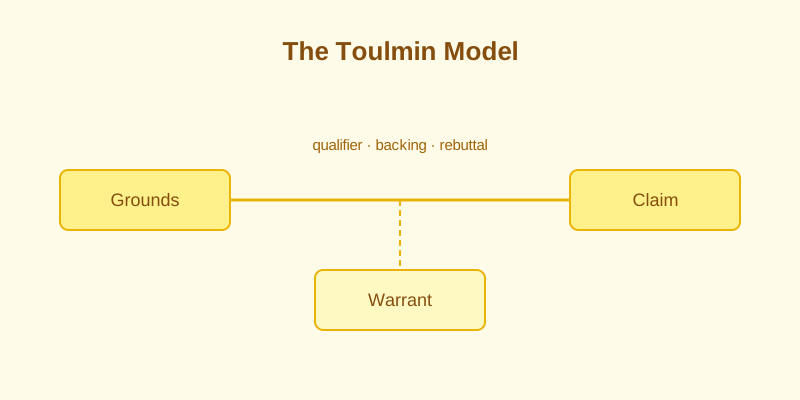
An argumentative essay asks you to take a position on a debatable question and defend it with evidence and reasoning. It sounds simple, but many student essays that call themselves “arguments” are really opinions with a few facts attached. A real argument shows the reader why the evidence supports the claim, and it takes the other side seriously.
This guide teaches a practical framework for building arguments, the Toulmin model, and walks you through researching, outlining, and drafting an argumentative essay from start to finish.
Looking for a guide focused more on audience and emotional appeal? See how to write a persuasive essay.
Argumentative vs. Persuasive Essays
The two are closely related, and many teachers use the terms interchangeably. When they are distinguished, the difference is mostly one of emphasis:
| Argumentative | Persuasive | |
|---|---|---|
| Main tool | Evidence and logical reasoning | Appeals to values, emotion, and credibility, as well as logic |
| Opposing views | Examined in depth, often with their own section | Acknowledged and answered, sometimes briefly |
| Tone | Measured, analytical | Can be more passionate |
| Research | Usually research-based with citations | May rely more on reasoning and examples |
In practice, the best essays in either category combine sound evidence with an awareness of the reader.
The Toulmin Model: Anatomy of an Argument
The philosopher Stephen Toulmin proposed that everyday arguments are made of six parts. You don’t need to label them in your essay, but knowing them helps you spot gaps in your reasoning.
1. Claim
The position you are arguing for. Your thesis is your main claim; each body paragraph makes a supporting claim.
Claim: Our town should convert the downtown parking lot into a public park.
2. Grounds (evidence)
The facts, data, examples, or expert testimony that support the claim.
Grounds: A survey of local residents found that most respondents would visit a downtown park weekly, and the parking lot is less than half full on most days.
3. Warrant
The assumption or principle that connects the grounds to the claim. Warrants are often unstated, and that’s where weak arguments hide.
Warrant: Public land should be used in the way that benefits the most residents.
If a reader doesn’t accept your warrant, your evidence won’t persuade them, no matter how strong it is. So ask yourself: What do I have to believe for this evidence to prove my claim?
4. Backing
Support for the warrant itself, when it might be questioned.
Backing: The town charter states that public land must serve “the general welfare of residents,” and studies of urban green spaces associate them with improved physical and mental health.
5. Qualifier
Words that show how strong your claim is: probably, in most cases, generally, likely. Qualifiers make your argument more accurate and harder to attack.
Qualified claim: Converting the lot to a park would likely benefit more residents than keeping it for parking.
6. Rebuttal
Conditions under which the claim might not hold, plus your response to objections.
Rebuttal: Some downtown businesses worry about losing customer parking. However, the lot’s low occupancy suggests that the remaining street parking and the garage two blocks away could absorb demand, and parks tend to increase foot traffic to nearby shops.
Step 1: Choose a Debatable Question
Start with a question, not an answer. Good argumentative questions:
- Have at least two reasonable answers
- Can be answered with evidence (not purely matters of taste or faith)
- Are narrow enough for your word count
| Too broad | Better |
|---|---|
| Is technology good or bad? | Should secondary schools ban phones during the school day? |
| Should we protect the environment? | Should our city charge a fee for single-use plastic bags? |
| Is social media harmful? | Should social media platforms be required to verify users’ ages? |
Step 2: Research Before You Decide
Begin with an open mind. Read sources on both sides before committing to a position. This makes your argument stronger, because you’ll understand the best objections before you write.
Evaluating sources
Not all evidence is equal. Use these questions to judge a source:
- Authority: Who wrote it? What are their qualifications?
- Accuracy: Is the information supported by evidence? Can it be verified elsewhere?
- Objectivity: Does the author or publisher have a reason to be biased? Is it funded by an interested party?
- Currency: When was it published? Is it recent enough for your topic?
- Purpose: Is it trying to inform, persuade, or sell something?
Prefer peer-reviewed research, government and academic sources, and reputable news organizations. Use advocacy group publications carefully: they can be useful for understanding a position but may present evidence selectively.
Step 3: Write Your Thesis
Your thesis is your main claim. Using a qualifier and naming your reasons makes it stronger:
Secondary schools should require students to store their phones during class time, because doing so reduces distraction, supports face-to-face social interaction, and helps teachers address cyberbullying, although schools must provide clear exceptions for emergencies and medical needs.
Notice the qualifying “although” clause. It shows from the start that you’ve considered the complications. For more on this, see how to write a strong thesis statement.
Step 4: Outline Your Essay
A classic argumentative structure:
- Introduction: hook, context, thesis
- Body paragraph 1: first supporting claim + evidence + warrant
- Body paragraph 2: second supporting claim + evidence + warrant
- Body paragraph 3: third supporting claim + evidence + warrant
- Counterargument and rebuttal: the strongest opposing view and your response
- Conclusion: restate thesis, synthesize, and explain significance
An alternative is the Rogerian structure, useful for highly divisive topics: start by fairly stating the opposing view and the common ground you share, then present your position as a way to address shared concerns. This can be more persuasive with a hostile audience.
Step 5: Draft Body Paragraphs With the Toulmin Model
Each body paragraph is a mini-argument. Here is an example with each element labeled:
[Claim] Storing phones during class reduces distraction and improves learning. [Grounds] Research on multitasking consistently finds that switching attention between tasks reduces comprehension and memory, and several studies of classroom phone policies have reported improved test scores after restrictions were introduced, with the largest gains among lower-achieving students. [Warrant] If a policy measurably improves learning, particularly for students who are struggling most, schools have a responsibility to consider it. [Qualifier] While results vary between schools, [Rebuttal/limit] and some students use phones for legitimate learning purposes, the overall evidence suggests that the default should be phones away, with teachers able to allow them for specific activities.
Notice that the paragraph doesn’t just present evidence; it explains why that evidence matters (the warrant). This is where many essays lose marks.
Step 6: Write a Strong Counterargument Section
The counterargument section is where argumentative essays prove their credibility.
- Choose the strongest objection, not the easiest one to knock down. Refuting a weak version of the other side (a “straw man”) convinces no one.
- State it fairly, as its supporters would.
- Respond in one of three ways:
- Refute: show it’s based on faulty evidence or reasoning
- Concede and outweigh: admit it has merit, but show your benefits are greater
- Concede and adapt: adjust your proposal to address the concern
Many parents argue that students need their phones in case of emergency. This is a legitimate concern. However, a storage policy does not prevent contact: phones remain on campus, school offices can relay urgent messages, and the policy can include exceptions for students with medical needs. The concern is a reason to design the policy carefully, not a reason to reject it.
Step 7: Watch for Logical Fallacies
Fallacies are errors in reasoning that weaken arguments. Check your draft for these common ones:
- Hasty generalization: drawing a broad conclusion from too little evidence (“My cousin’s school banned phones and grades went up, so bans always work.”)
- Straw man: misrepresenting the opposing view to make it easier to attack
- False dilemma: presenting only two options when more exist (“Either we ban phones or we accept that students won’t learn.”)
- Slippery slope: claiming one step will inevitably lead to extreme consequences without evidence
- Ad hominem: attacking the person rather than their argument
- Appeal to popularity: “Everyone agrees that…” Popularity doesn’t make something true.
- Correlation vs. causation: assuming that because two things happen together, one causes the other
Step 8: Conclude With Significance
Your conclusion should restate your thesis in light of the evidence, show how your points fit together, and explain why the argument matters. For strategies, see how to write a conclusion.
Argumentative Essay Checklist
- My question is genuinely debatable and narrow enough.
- I researched both sides before deciding.
- My thesis states a clear, qualified position.
- Each body paragraph has a claim, evidence, and an explained warrant.
- My sources are credible and correctly cited.
- I address the strongest counterargument fairly.
- I’ve checked for logical fallacies.
- My conclusion explains why the argument matters.
Practice Exercise
Choose one of these questions:
- Should voting be compulsory?
- Should homework be optional in secondary school?
- Should cities ban cars from their historic centers?
For your chosen question, write down: a claim, one piece of grounds, the warrant that connects them, a qualifier, and the strongest rebuttal with your response. That’s one complete Toulmin argument, and three of them make the body of an essay. To see how those arguments fit into the full essay, read what are the parts of an argumentative essay, then plan your draft with our essay outline templates.
Keep Learning
How to Do a Literacy Essay: Write a Literacy Narrative Readers Connect With
A step-by-step guide to writing a literacy essay (literacy narrative): choosing a meaningful moment, structuring your story, reflecting on what it means, plus an original example and topic ideas.
Essay WritingWhat Is a Great Thesis Statement? 7 Tests That Separate Good From Great
What makes a thesis statement great, not just correct? Use seven simple tests to evaluate and upgrade your thesis, with before-and-after examples showing how average claims become memorable ones.
Essay WritingHow Do You Write an Essay Outline? A 5-Step Method With Templates
Learn how to write an essay outline in five steps, with free templates for five-paragraph, argumentative, and compare-and-contrast essays, plus a filled-in example and tips for turning your outline into a draft.