 Javed Ali • • 8 min read • Essay Writing
How to Write a Cause and Effect Essay: Structures, Thesis Examples, and Outline
Learn how to write a cause and effect essay step by step: choose a manageable topic, pick one of three structures, write a clear thesis, prove causation instead of just correlation, and use the right transitions. Includes a full outline and checklist.
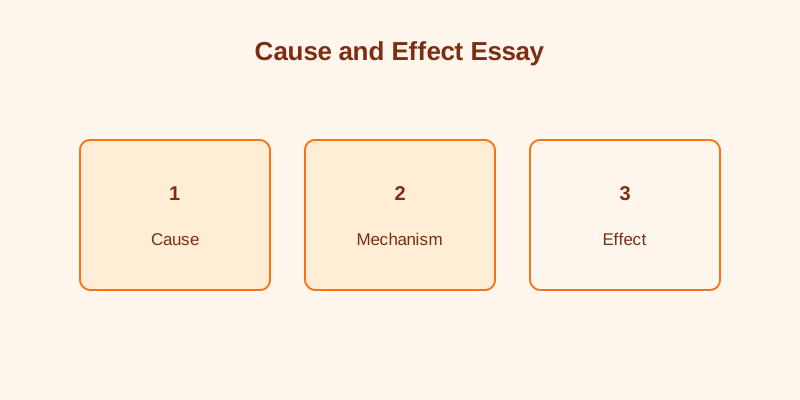
Why did that happen? What will happen because of it? These are two of the most natural questions people ask, and a cause and effect essay is built to answer them.
It’s a common assignment in history, science, social studies, and composition classes, and a frequent prompt on standardized tests. Done well, it shows that you can do more than list facts: you can explain how one event leads to another. This guide walks you through choosing a topic, structuring the essay, and writing paragraphs that actually prove the connections you claim.
What Is a Cause and Effect Essay?
A cause and effect essay explains the relationship between events: why something happened, what it led to, or both.
- A cause is the reason something happens.
- An effect is the result.
The key word is relationship. Describing an event isn’t enough. Your job is to show the link: how the cause produced the effect.
Prompts usually signal this type with words like why, causes, effects, consequences, impact, result, led to, or influence. For example:
- What caused the decline of the silent film industry?
- What are the effects of sleep deprivation on students?
- How did the printing press change European society?
Step 1: Choose a Manageable Topic
The biggest risk with cause and effect essays is choosing a topic so large that you can only skim it. “The causes of World War I” fills entire books. “How the alliance system turned a regional conflict into a continental war” fits an essay.
A good topic has:
- A clear event or trend at its center
- Causes or effects you can actually support with evidence
- A scope that fits your length: usually two to four main causes or effects for a short essay
Topic ideas:
- Effects of a later school start time on teenagers
- Causes of the rise of streaming over cable television
- Effects of the printing press on European literacy
- Why some new year’s resolutions fail
- Effects of social media on how news spreads
- Causes of urban heat islands
- Effects of remote work on city downtowns
- Why a local business or tradition declined in your community
Step 2: Decide What You’re Explaining
Before outlining, decide which of three focuses your essay will take:
- Causes: one effect, several causes. Why did X happen?
- Effects: one cause, several effects. What did X lead to?
- Causal chain: each effect becomes the next cause. How did A lead to B, which led to C?
Many assignments specify the focus. If yours doesn’t, choose the one where you have the strongest evidence.
Step 3: Pick a Structure
Each focus has a natural structure.
Structure 1: Multiple Causes → One Effect
- Introduction (thesis names the effect and its main causes)
- Body 1: Cause 1
- Body 2: Cause 2
- Body 3: Cause 3
- Conclusion
Structure 2: One Cause → Multiple Effects
- Introduction (thesis names the cause and its main effects)
- Body 1: Effect 1
- Body 2: Effect 2
- Body 3: Effect 3
- Conclusion
Structure 3: Causal Chain
- Introduction (thesis summarizes the chain)
- Body 1: Event A causes B
- Body 2: B causes C
- Body 3: C causes D
- Conclusion
The causal chain is the most impressive when it works, because it shows how events build on each other. It’s also the hardest to support, since every link needs evidence.
Ordering tip: In structures 1 and 2, arrange your points either chronologically or by importance. Ending with the most significant cause or effect gives your essay momentum.
Step 4: Write a Clear Thesis
A cause and effect thesis names the central event and previews the causes or effects you’ll explain. A reliable formula:
[Event or trend] + [caused by / led to] + [your main causes or effects]
Causes thesis:
Cable television lost viewers to streaming because streaming offered lower prices, on-demand viewing, and original programming that cable couldn’t match.
Effects thesis:
The printing press transformed European society by making books cheaper, spreading literacy beyond the clergy and elite, and allowing new ideas to circulate faster than authorities could control them.
Causal chain thesis:
Losing an hour of sleep each night sets off a chain of problems for students: tiredness reduces focus in class, poor focus leads to lower-quality homework, and falling grades increase the stress that makes sleep even harder.
Argumentative version (ranks the causes):
Although price played a role, streaming’s real advantage over cable was control: viewers, not networks, decided when and what to watch.
For more help, see our guide on how to write a thesis statement.
Step 5: Prove Causation, Not Just Correlation
This is the step that separates strong essays from average ones.
Correlation means two things happen together. Causation means one actually produces the other. Many weak essays assume that because one thing came first, it caused the second. Logicians call this the post hoc fallacy: “after this, therefore because of this.”
Weak: Our town opened a new mall in 2015, and the downtown shops started closing in 2016. The mall caused the shops to close.
Maybe it did. But maybe rents rose, or online shopping grew, or the owners retired. The timing alone doesn’t prove anything.
To show real causation:
- Explain the mechanism. How exactly did the cause produce the effect? Walk the reader through the steps.
- Use evidence. Data, expert explanations, documented examples, or historical records.
- Consider other causes. Acknowledging alternative explanations, then showing why yours matters, makes you more credible, not less.
- Use careful language. Words like contributed to, helped cause, and was one factor in are often more accurate than caused.
Stronger: When the mall opened with free parking and longer hours, several downtown shop owners reported a sharp drop in weekend customers. Combined with rising downtown rents, this loss of foot traffic left smaller shops with less income to cover higher costs. The mall did not close the shops by itself, but it removed the weekend sales many of them depended on.
(This is an invented example. In a real essay, cite your sources.)
Step 6: Write Body Paragraphs That Show the Link
Each body paragraph covers one cause or one effect. Inside the paragraph, follow the familiar pattern from our guide on how to write a body paragraph:
- Topic sentence: names the cause or effect
- Evidence: shows it happened
- Analysis: explains how it connects to the central event
- Link: ties back to the thesis or leads to the next point
Example body paragraph (effects essay):
The first major effect of the printing press was a dramatic drop in the cost of books. Before printing, every book had to be copied by hand, a process that could take a scribe months for a single volume. Once Gutenberg’s movable type spread across Europe in the second half of the fifteenth century, a print shop could produce many identical copies in the time it once took to make one. As each copy became cheaper to make, books moved from the libraries of monasteries and wealthy families into the hands of merchants, students, and ordinary townspeople. This change in price is the foundation for every other effect: before literacy could spread, there had to be something affordable to read.
Notice how the last sentence prepares for the next effect (spreading literacy). That’s the causal relationship working between paragraphs, not just within them.
Use Cause and Effect Transitions
Transitions make the relationships between ideas visible. Use them deliberately:
| To show a cause | To show an effect |
|---|---|
| because, since, due to | as a result, therefore, consequently |
| owing to, as a result of | thus, so, hence |
| one reason is | this led to, this resulted in |
| this was caused by | for this reason, accordingly |
Vary them. Repeating “as a result” six times makes an essay sound mechanical. See our full list of transition words for essays.
Full Example Outline
Topic: Effects of the printing press on European society
Introduction
- Hook: For most of European history, every book was copied by hand, one letter at a time.
- Context: Gutenberg’s movable type press appeared in the mid-1400s.
- Thesis: The printing press transformed European society by making books cheaper, spreading literacy beyond the clergy and elite, and allowing new ideas to circulate faster than authorities could control them.
Body 1: Books became cheaper
- Hand copying was slow and expensive.
- Printing produced many identical copies quickly.
- Lower cost moved books into ordinary households.
Body 2: Literacy spread
- Affordable books gave more people a reason and a way to learn to read.
- Reading spread among merchants and townspeople, not just clergy.
- Printed texts also helped standardize spelling and language.
Body 3: Ideas spread faster than they could be controlled
- Pamphlets could be printed and distributed in large numbers quickly.
- Religious and scientific debates reached wide audiences.
- Authorities struggled to suppress ideas once printed copies existed.
Conclusion
- Synthesis: each effect enabled the next, from cheaper books to more readers to faster-moving ideas.
- Significance: a useful lens for thinking about how new technologies change who has access to information.
Writing the Introduction and Conclusion
Introduction: Open with a hook that makes the central event feel significant, give brief background, and end with your thesis. Our guide to writing an essay introduction covers seven types of hooks.
Conclusion: Show how the causes or effects fit together as a whole, then answer “so what?” Why does understanding this relationship matter? Could it help explain a similar situation today? Avoid introducing a brand-new cause or effect at the end. See how to write a conclusion.
Common Mistakes
- Assuming causation from timing alone. Explain the mechanism.
- Oversimplifying. Most events have several causes. Claiming one single cause is usually inaccurate.
- Listing instead of explaining. Naming three causes isn’t the same as showing how each one worked.
- Confusing causes and effects. Keep your focus clear and consistent.
- Topic too broad. You’ll end up with surface-level paragraphs.
- Missing evidence. Every causal claim needs support.
Cause and Effect Essay Checklist
- Is my topic narrow enough for the length?
- Have I chosen a clear focus: causes, effects, or a chain?
- Does my thesis name the event and its main causes or effects?
- Does each body paragraph explain how the cause produced the effect?
- Have I avoided assuming causation from timing alone?
- Do I acknowledge other possible causes where relevant?
- Have I used varied cause and effect transitions?
- Does my conclusion explain why the relationship matters?
Practice Exercise
Pick a small change you’ve seen in your own life or community: a new rule at school, a store that closed, a habit you started or stopped. Write down the change in one sentence. Then brainstorm every cause you can think of in two minutes. Circle the three most important and, for each one, write one sentence explaining how it led to the change, not just that it did. If you can’t explain the mechanism, you may have found a correlation rather than a cause. Turn your best three into a thesis using the formula above, then build your outline. When your draft is done, run it through our proofreading and editing guide.
Frequently Asked Questions
What is a cause and effect essay?
How many causes or effects should I include?
What is the difference between correlation and causation?
Can a cause and effect essay be argumentative?
Keep Learning
How to Write a Literary Analysis Essay: From Close Reading to Final Draft
Learn how to write a literary analysis essay step by step: read closely, find a pattern, write an interpretive thesis, and analyze quotations in depth. Includes a worked example on Robert Frost's 'The Road Not Taken,' a sample paragraph, and a checklist.
Essay WritingHow to Write a Body Paragraph: Topic Sentence, Evidence, Analysis, and Link
Learn how to write strong body paragraphs for any essay using a four-part structure: topic sentence, evidence, analysis, and link. Includes annotated examples, a weak-to-strong revision, length guidelines, and a checklist.
Essay WritingHow to Write an Expository Essay: Types, Structure, and Example
Learn how to write an expository essay that explains a topic clearly and objectively. Covers the five main types, a thesis formula, body paragraph structure, an example outline, common mistakes, and a checklist.