Transition Words for Essays: 150+ Examples and How to Use Them
A categorized list of transition words and phrases for essays, with example sentences, punctuation rules, and advice on moving smoothly between sentences and paragraphs.
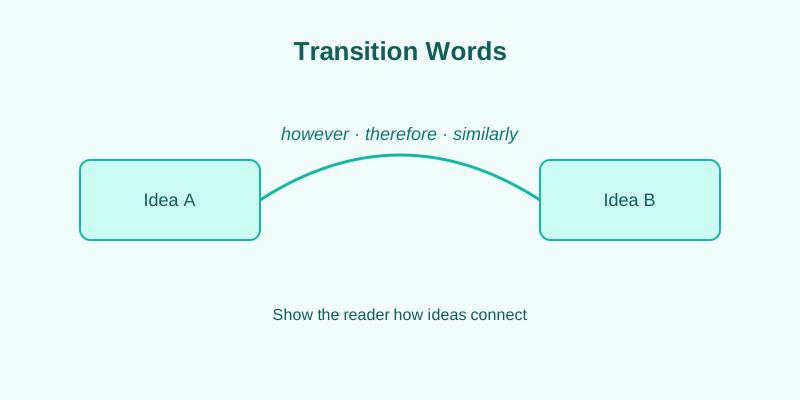
Transition words are the signposts of writing. They tell your reader how one idea relates to the next: whether you’re adding a point, contrasting it, giving an example, or drawing a conclusion. Without them, even well-researched essays can feel like a list of disconnected statements. With them, your argument reads as a single line of reasoning.
This guide lists more than 150 transition words and phrases, organized by the relationship they express, with example sentences, punctuation rules, and tips on using them well.
Why Transitions Matter
Compare these two passages:
Without transitions:
Electric cars produce no tailpipe emissions. Their batteries require mining for lithium and cobalt. Mining can damage local environments. Electric cars are still generally better for the climate over their lifetime.
With transitions:
Electric cars produce no tailpipe emissions. However, their batteries require mining for lithium and cobalt, and this mining can damage local environments. Even so, most lifecycle studies find that electric cars are still better for the climate over their lifetime.
The facts are the same. The second version shows the reader how they connect: a benefit, a drawback, and a conclusion that weighs them.
Transition Words by Category
1. Adding information
Use these when you’re building on a previous point in the same direction.
and, also, in addition, additionally, furthermore, moreover, besides, as well as, equally important, not only… but also, likewise, what is more, another, too, along with
Later school start times improve attendance. In addition, they are associated with fewer car accidents among teenage drivers.
2. Contrasting and showing difference
Use these when the next idea goes against, qualifies, or differs from the previous one.
however, but, yet, on the other hand, in contrast, conversely, nevertheless, nonetheless, although, even though, though, whereas, while, despite, in spite of, still, on the contrary, unlike, instead, rather, even so, all the same, at the same time
Remote work saves commuting time. On the other hand, it can make collaboration more difficult.
3. Comparing and showing similarity
similarly, likewise, in the same way, just as, equally, correspondingly, by the same token, in a similar fashion, comparably, like
Shakespeare’s Macbeth is destroyed by ambition. Similarly, Marlowe’s Doctor Faustus is ruined by his hunger for knowledge and power.
4. Giving examples and illustrating
for example, for instance, such as, to illustrate, namely, specifically, in particular, including, as an illustration, to demonstrate, consider, take the case of, notably, especially
Many everyday products rely on rare earth elements. For example, smartphones use them in their screens, speakers, and vibration motors.
5. Showing cause and effect
Use these to explain why something happened or what resulted.
because, since, as, due to, owing to, as a result, therefore, thus, consequently, hence, for this reason, so, accordingly, it follows that, leads to, results in, on account of, in effect
The bridge was closed for repairs. As a result, traffic through the town center doubled.
6. Emphasizing a point
indeed, in fact, above all, especially, particularly, clearly, certainly, of course, undoubtedly, most importantly, significantly, notably, in particular, it should be noted that, to emphasize
Sleep affects memory, mood, and concentration. Above all, it is when the brain consolidates what it learned during the day.
7. Showing sequence and order
Use these to organize steps, events, or arguments.
first, second, third, firstly, secondly, next, then, after that, afterward, subsequently, following this, meanwhile, finally, lastly, to begin with, initially, eventually, in the meantime, simultaneously, previously, before, prior to
First, preheat the oven. Next, mix the dry ingredients. Finally, fold in the eggs and butter.
8. Showing time
when, while, during, as soon as, until, before, after, since, at that time, by the time, now, immediately, soon, in the past, currently, recently, at present, formerly, at the same time, later
By the time the government responded, the floodwaters had already reached the city.
9. Conceding a point
Use these to acknowledge an opposing view before responding to it. They are especially useful in argumentative essays.
admittedly, granted, of course, it is true that, although, even though, while it may be true that, to be sure, certainly, despite this, regardless
Admittedly, uniforms reduce the pressure to wear expensive brands. Nevertheless, they impose their own costs on families.
10. Clarifying and restating
in other words, that is, to put it another way, to clarify, namely, put simply, more precisely, to be more specific, which is to say, i.e.
The policy was regressive. In other words, it placed a heavier burden on low-income families than on wealthy ones.
11. Showing place or position
Most useful in descriptive and narrative writing.
above, below, beside, beyond, nearby, opposite, adjacent to, in front of, behind, here, there, in the distance, in the background, to the left, to the right
In the distance, the mountains disappeared into the clouds.
12. Summarizing and concluding
in conclusion, to conclude, in summary, to summarize, overall, ultimately, in short, in brief, all in all, on the whole, taken together, as has been shown, given these points, in the final analysis, in the end
Taken together, these findings suggest that the policy has done more harm than good.
Transitions Between Paragraphs
Single words like however and furthermore connect sentences. Between paragraphs, you often need something stronger: a transitional sentence that links the idea you just finished to the one you’re starting.
A good technique is to refer back to the previous paragraph’s idea while introducing the new one:
[End of paragraph on economic benefits] …making the program more than pay for itself within five years.
[Start of next paragraph] Yet the program’s financial benefits, though significant, are less important than its effect on public health.
Notice how “financial benefits” refers back while “effect on public health” introduces the new topic. The reader never loses the thread.
Other useful patterns:
- “While [previous idea] is important, [new idea] is even more significant.”
- “Beyond [previous idea], [new idea] also plays a role.”
- “[Previous idea] raises an obvious question: [new idea]?”
- “If [previous idea] explains why, [new idea] explains how.”
Punctuation Rules for Transitions
Getting the punctuation right matters, especially with words like however and therefore.
1. At the start of a sentence: follow the transition with a comma.
However, the results were inconclusive.
2. Joining two complete sentences: use a semicolon before and a comma after. A comma alone creates a comma splice.
The data was limited**; however,** the trend was clear. ✅ The data was limited**, however,** the trend was clear. ❌ (comma splice)
3. In the middle of a sentence: surround the transition with commas.
The trend, however, was clear.
4. Coordinating conjunctions (and, but, or, so, yet, for, nor) joining two complete sentences take a comma before them:
The data was limited**, but** the trend was clear.
5. Subordinating conjunctions (because, although, since, while, whereas) introduce a dependent clause. Use a comma when the clause comes first:
Although the data was limited, the trend was clear. The trend was clear although the data was limited.
Tips for Using Transitions Well
- Choose the right relationship. Don’t write however when you mean furthermore. A wrong transition is worse than none, because it actively misleads the reader.
- Don’t overuse them. Not every sentence needs a transition. If every sentence starts with Moreover or Furthermore, your writing becomes mechanical. Often, a logical sequence of ideas connects itself.
- Vary your choices. If you use however three times in one paragraph, swap in yet, nevertheless, or in contrast.
- Match the register. Moreover and consequently suit formal essays. Plus and anyway are too casual for academic writing.
- Avoid formulaic sequences. “Firstly… Secondly… Thirdly… Lastly…” can work for short pieces but often feels like a list rather than an argument. Try transitions that show how points relate.
- Read aloud. If a passage sounds choppy, you probably need a transition. If it sounds padded, you probably have too many.
Practice Exercise
Add transitions to this paragraph to show how the ideas connect:
Social media allows people to stay in touch with friends and family around the world. It can expose users to misinformation. Some platforms have introduced fact-checking labels. Studies on their effectiveness show mixed results. Users need to develop their own critical thinking skills.
One possible answer:
Social media allows people to stay in touch with friends and family around the world. At the same time, it can expose users to misinformation. In response, some platforms have introduced fact-checking labels; however, studies on their effectiveness show mixed results. Ultimately, therefore, users need to develop their own critical thinking skills.
Transitions are one of the fastest ways to make writing feel more polished. For the bigger picture of how paragraphs fit together, see our guide to essay structure.
Keep Learning
How to Do a Literacy Essay: Write a Literacy Narrative Readers Connect With
A step-by-step guide to writing a literacy essay (literacy narrative): choosing a meaningful moment, structuring your story, reflecting on what it means, plus an original example and topic ideas.
Essay WritingWhat Is a Great Thesis Statement? 7 Tests That Separate Good From Great
What makes a thesis statement great, not just correct? Use seven simple tests to evaluate and upgrade your thesis, with before-and-after examples showing how average claims become memorable ones.
Essay WritingHow Do You Write an Essay Outline? A 5-Step Method With Templates
Learn how to write an essay outline in five steps, with free templates for five-paragraph, argumentative, and compare-and-contrast essays, plus a filled-in example and tips for turning your outline into a draft.