How to Write a Narrative Essay: Turn Your Experience Into a Story
Learn how to choose a meaningful experience, structure it as a story, use dialogue and sensory detail, and reflect on what it means, with a sample paragraph and topic ideas.
A narrative essay tells a true story from your own life, and then shows what that story means. It is the essay type closest to fiction: it uses scenes, characters, dialogue, and suspense. But unlike a short story, a narrative essay has a purpose beyond entertainment. It makes a point about what you learned, how you changed, or what you came to understand.
Narrative essays appear in school assignments, college and university applications, scholarship essays, and personal statements. This guide shows you how to choose the right story, structure it, bring it to life, and connect it to a meaningful insight.
What Makes a Narrative Essay Different?
| Narrative essay | Argumentative essay | |
|---|---|---|
| Purpose | Share an experience and its meaning | Prove a claim |
| Point of view | Usually first person (“I”) | Usually third person |
| Evidence | Scenes, details, dialogue | Facts, data, sources |
| Structure | Often chronological, built around a story arc | Thesis, supporting paragraphs, counterargument |
| “Thesis” | An insight or lesson, sometimes revealed gradually | A clear claim stated early |
The “thesis” of a narrative essay is the insight: the thing the experience taught you. It might be stated in the introduction, revealed at the end, or both.
Step 1: Choose the Right Story
The most common mistake is choosing a story that’s too big. “My summer in Spain” or “my high school years” are not stories; they’re periods of time. A narrative essay works best when it focuses on a single moment or short sequence of events that led to a change.
Good narrative topics often involve:
- A challenge you faced and how you responded
- A first: first job, first failure, first time standing up for something
- A turning point that changed your perspective
- A conflict with someone else, or within yourself
- A small moment that turned out to matter more than you expected
Notice that the story doesn’t need to be dramatic. Some of the best narrative essays are about ordinary moments (a conversation with a grandparent, a lost game, a wrong turn) told with honesty and insight. What matters is not how exciting the event was, but how deeply you reflect on it.
Ask yourself:
- Did this experience change how I think, act, or see myself?
- Can I describe specific moments in vivid detail?
- Can I tell it within the word limit?
Topic ideas to get you started
- A time you failed at something you cared about
- A moment when you realized an adult was wrong
- The first time you felt responsible for someone else
- A conversation that changed your mind
- A tradition in your family and what it means to you
- A time you were an outsider
- A mistake you made and how you fixed it
- An object that holds an important memory
- The moment you decided to quit (or not to quit) something
- A time you helped a stranger, or a stranger helped you
Step 2: Find the Insight
Before you write, answer this question: “What did this experience teach me?”
Then push past the first, obvious answer. “I learned that hard work pays off” is a cliché. Try to make your insight more specific and honest:
-
Generic: I learned to never give up.
-
Specific: I learned that persistence isn’t about refusing to stop; it’s about being willing to change your approach when the first one fails.
-
Generic: I learned to appreciate my family.
-
Specific: I realized that my father’s silence at the dinner table wasn’t indifference. It was exhaustion from a job he took so that I wouldn’t have to.
The specific insight gives your essay depth and makes your reader think.
Step 3: Structure the Story
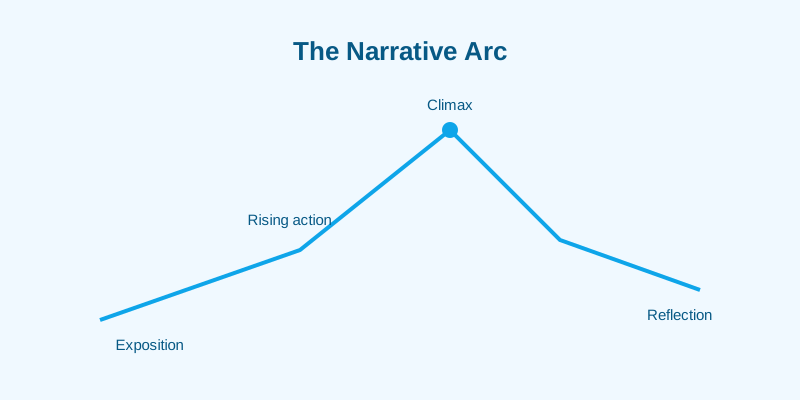
Most narrative essays follow a story arc:
- Introduction / exposition: Set the scene. Introduce the people, place, and situation. Often begins with a hook that drops the reader into a moment.
- Rising action: Build tension. What was the problem, goal, or conflict? What happened as it developed?
- Climax: The turning point, the moment of greatest tension or change.
- Falling action: What happened as a result?
- Conclusion / reflection: What did it mean? How did it change you?
Start in the middle
You don’t have to tell your story in strict chronological order. A powerful technique is to begin in the middle of the action (in medias res), at a moment of tension, and then fill in the background.
Chronological opening: “Last year, I decided to try out for the school debate team. I had never done debate before…”
In medias res opening: “The timer beeped. I had ninety seconds to rebut an argument I didn’t fully understand, in front of judges who had been debating since before I was born.”
The second version hooks the reader immediately.
Step 4: Show, Don’t Tell
This is the most important principle in narrative writing. Instead of telling the reader how you felt, show them through details, actions, and dialogue so they experience it with you.
Telling: I was very nervous before my audition.
Showing: I read the first line of my monologue for the fifteenth time. My hands left damp prints on the paper. When the director called my name, I stood up so quickly that my chair scraped across the floor, and everyone turned to look.
Use sensory details
Engage all five senses, not just sight:
- Sound: the scrape of the chair, a ticking clock, a voice cracking
- Smell: burnt toast, chlorine, rain on hot pavement
- Touch: damp paper, a cold door handle, the weight of a backpack
- Taste: metallic fear, overly sweet hospital juice
- Sight: specific colors, movements, expressions
You don’t need every sense in every scene. One or two precise details are more powerful than a long list.
Use dialogue
Dialogue brings characters to life and moves the story forward. Keep it short and purposeful.
“You’re going to forget your lines,” my brother said, not looking up from his phone. “Thanks,” I said. “I’m just saying. You always do.”
Three short lines reveal the relationship, the tension, and the stakes. Format dialogue correctly: start a new paragraph for each new speaker, and put punctuation inside the quotation marks.
Step 5: Reflect
Reflection is what turns a story into an essay. Without it, you have an anecdote; with it, you have meaning.
Reflection usually comes most heavily at the end, but it can also appear throughout, in brief moments where your present-day self comments on your past self:
I didn’t know it then, but that was the last time I would hear him play.
In your conclusion, connect the experience to your insight and, if possible, to the present or future: how do you think or act differently now?
I still forget lines sometimes. Last month, in the middle of my final performance, I lost an entire speech. But this time I didn’t freeze. I said what the character would have said, in my own words, and kept going. Somewhere between that first audition and that last night, I had learned that the script was never the point. The point was to stay in the scene.
Sample Narrative Paragraph
The first time I tried to cook dinner for my family, I set off the smoke alarm twice. My mother had worked a double shift, and I wanted to surprise her with her favorite dish, chicken adobo, the way my grandmother made it. I had watched my grandmother cook it a hundred times, but I had never once asked how. Standing in a kitchen full of smoke, holding a pan of blackened chicken, I realized that watching someone and learning from them are not the same thing. The next weekend, I called my grandmother and asked her to teach me properly. She laughed for a full minute before she said yes.
This paragraph opens with a concrete, slightly humorous moment, gives context, builds to a realization, and ends with action and character.
Common Mistakes
- Too much summary, not enough scene. Slow down at the important moments and zoom in.
- Too many events. Focus on one key experience rather than covering weeks or years.
- Clichéd lessons. Push past “I learned to never give up” toward something specific and honest.
- No reflection. Every narrative essay needs to explain what the experience meant.
- Telling the reader how to feel. Let the details create the emotion.
- Inconsistent tense. Most narratives use past tense; whichever you choose, stay consistent.
Narrative Essay Checklist
- My story focuses on a single, specific experience.
- My opening drops the reader into a moment.
- I show rather than tell, using sensory details and dialogue.
- My story builds to a clear turning point.
- My insight is specific, honest, and not a cliché.
- My conclusion reflects on what the experience means now.
Practice Exercise
Set a timer for ten minutes. Choose one topic from the list above and write only the single most important moment of the story, in as much sensory detail as possible. Don’t worry about the beginning or the end yet. When the timer goes off, underline every sentence that tells a feeling and rewrite it to show the feeling instead.
That moment is the heart of your essay. Everything else is built around it. Once you have a draft, polish it with our guide to proofreading and editing. If your story is about reading, writing, or language, our guide to writing a literacy essay shows how to add the reflection that assignment requires.
Keep Learning
How to Do a Literacy Essay: Write a Literacy Narrative Readers Connect With
A step-by-step guide to writing a literacy essay (literacy narrative): choosing a meaningful moment, structuring your story, reflecting on what it means, plus an original example and topic ideas.
Essay WritingWhat Is a Great Thesis Statement? 7 Tests That Separate Good From Great
What makes a thesis statement great, not just correct? Use seven simple tests to evaluate and upgrade your thesis, with before-and-after examples showing how average claims become memorable ones.
Essay WritingHow Do You Write an Essay Outline? A 5-Step Method With Templates
Learn how to write an essay outline in five steps, with free templates for five-paragraph, argumentative, and compare-and-contrast essays, plus a filled-in example and tips for turning your outline into a draft.