How Do You Write an Essay Outline? A 5-Step Method With Templates
Learn how to write an essay outline in five steps, with free templates for five-paragraph, argumentative, and compare-and-contrast essays, plus a filled-in example and tips for turning your outline into a draft.
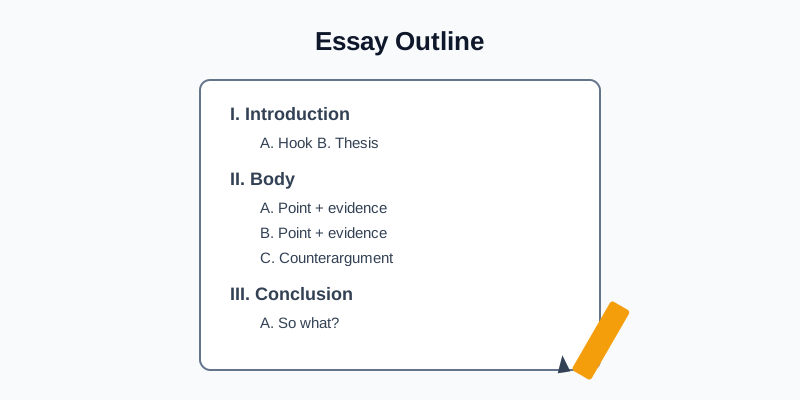
Staring at a blank page is hard. Staring at a blank page while trying to decide what to say, in what order, and with what evidence, all at the same time, is harder. An outline separates those decisions. You plan the structure first, so that when you draft, you only have to focus on writing good sentences.
This guide answers the question “How do you write an essay outline?” with a simple five-step method, ready-to-use templates for common essay types, and a complete filled-in example.
What Is an Essay Outline?
An essay outline is a plan that lists your thesis, the main point of each body paragraph, and the evidence that supports each point, in the order they will appear. It is the skeleton of your essay.
A good outline lets you:
- See your argument at a glance and spot gaps before you write.
- Check that every paragraph supports the thesis.
- Write faster, because you always know what comes next.
- Stay within the word count, because you can see how much material each section needs.
Some instructors require a formal outline to be submitted. Even when they don’t, ten or fifteen minutes of outlining usually saves far more time during drafting and revision.
Formal vs. Informal Outlines
An informal (working) outline uses short phrases and bullet points. It is quick and flexible, ideal for timed essays, exams, and early planning.
A formal outline uses a consistent numbering system and often full sentences. It is common when an instructor asks you to submit an outline. The traditional system looks like this:
I. Main section
   A. Supporting point
      1. Detail or evidence
         a. Further detail
If your instructor gives a format, follow it exactly. Otherwise, choose whichever style helps you think most clearly.
How to Write an Essay Outline in 5 Steps
Step 1: Understand the Assignment
Before outlining, identify what the prompt asks you to do. Look for the key verb: argue, analyze, compare, explain, describe, or evaluate. Each verb implies a different structure. Also note the required length, the number of sources, and the citation style.
Step 2: Write a Working Thesis
Your thesis is the anchor of the outline. Every other line will support it. Write one sentence that answers the prompt with a specific, arguable claim. It does not need to be perfect yet; you will refine it as you plan. If you need help, see our guide on how to write a strong thesis statement.
Step 3: Brainstorm and Group Your Ideas
List every reason, example, quotation, and fact that could support your thesis. Don’t filter yet. Then group related items together. Each group will likely become a body paragraph.
Most essays of 1,000 words or fewer work well with three main groups. Longer essays may need four to six.
Step 4: Order Your Main Points
Decide on the sequence. Common options include:
- Strongest last (climactic order): build toward your most persuasive point.
- Strongest first: useful when readers may skim, or in timed exams.
- Chronological: for narratives, histories, and process essays.
- Logical dependency: when one point must be understood before the next makes sense.
Step 5: Add Evidence and Topic Sentences
Under each main point, write a topic sentence and list the specific evidence you will use, with a note on where it came from (page numbers or source names). Add a brief reminder of how the evidence connects back to your thesis. This connection, often called analysis, is what turns a list of facts into an argument.
Template 1: Five-Paragraph Essay Outline
I. Introduction
   A. Hook:
   B. Background / context:
   C. Thesis:

II. Body Paragraph 1
   A. Topic sentence (Point 1):
   B. Evidence:
   C. Analysis (how this supports the thesis):
   D. Transition:

III. Body Paragraph 2
   A. Topic sentence (Point 2):
   B. Evidence:
   C. Analysis:
   D. Transition:

IV. Body Paragraph 3
   A. Topic sentence (Point 3):
   B. Evidence:
   C. Analysis:

V. Conclusion
   A. Restated thesis (new wording):
   B. Synthesis of main points:
   C. Significance ("So what?"):
Template 2: Argumentative Essay Outline
I. Introduction
   A. Hook
   B. Background on the issue
   C. Thesis (your position + main reasons)

II. Reason 1 + evidence + analysis
III. Reason 2 + evidence + analysis
IV. Reason 3 + evidence + analysis

V. Counterargument
   A. Strongest opposing view (stated fairly)
   B. Rebuttal with evidence

VI. Conclusion
   A. Restated position
   B. Why the issue matters / call to action
For a full breakdown of each section, see what are the parts of an argumentative essay.
Template 3: Compare-and-Contrast Outline (Point-by-Point)
I. Introduction with thesis comparing Subject A and Subject B

II. Point of comparison 1
   A. Subject A
   B. Subject B
   C. What the comparison reveals

III. Point of comparison 2
   A. Subject A
   B. Subject B
   C. What the comparison reveals

IV. Point of comparison 3
   (same pattern)

V. Conclusion: what the comparison shows overall
Our compare and contrast essay guide explains when to use the point-by-point method versus the block method.
A Filled-In Example Outline
Prompt: Should high schools start later in the morning?
I. Introduction
   A. Hook: Picture a first-period class where half the students
      are struggling to keep their eyes open.
   B. Background: Many high schools begin before 8:00 a.m.;
      health organizations have raised concerns about teen sleep.
   C. Thesis: High schools should start no earlier than 8:30 a.m.
      because later start times support student health, improve
      attention in class, and make mornings safer for students
      who travel to school.

II. Health
   A. Topic sentence: Later start times align school schedules
      with adolescent sleep patterns.
   B. Evidence: Research on the shift in teenage sleep timing
      (cite a credible source, e.g., a public health agency).
   C. Analysis: Early schedules work against biology rather than
      against motivation.

III. Learning
   A. Topic sentence: Rested students are better able to focus
      and retain information.
   B. Evidence: Studies of districts that changed start times
      (cite specific sources found in research).
   C. Analysis: Attention is a prerequisite for learning.

IV. Safety
   A. Topic sentence: Later starts can reduce risks for students
      who drive or walk to school in the dark.
   B. Evidence: Source on drowsy driving among young drivers.
   C. Analysis: The schedule affects students outside the classroom.

V. Counterargument
   A. Opposing view: Later starts complicate bus routes,
      after-school jobs, and sports.
   B. Rebuttal: These are real logistical challenges, but districts
      can adjust schedules; the health costs fall on students daily.

VI. Conclusion
   A. Restate: Start times are a policy choice with health effects.
   B. Significance: A schedule change is one of the few reforms
      that benefits nearly every student at once.
Notice that the example includes notes like “cite a credible source.” In your own outline, write down the actual source and page number as soon as you find it. That small habit makes citing sources in MLA or APA much easier later.
Turning Your Outline Into a Draft
- Write the body first. Body paragraphs are the most concrete part, so drafting them first builds momentum. Many writers then write the introduction once they know exactly what it introduces.
- Turn each outline line into one to three sentences. The topic sentence becomes the first sentence of the paragraph; the evidence and analysis follow.
- Use transitions to connect sections. The outline shows the order; transition words make the order feel natural.
- Let the outline change. If you discover a better argument while drafting, update the outline rather than forcing your writing to fit an old plan.
Common Outlining Mistakes
- Main points that overlap. If two body paragraphs make the same point, merge them.
- No evidence listed. An outline with only topic sentences hides weak paragraphs until it is too late.
- A thesis that doesn’t match the body. Reread the thesis after outlining and adjust it so it covers every main point.
- Too much detail. An outline that is as long as the essay defeats the purpose.
- Skipping the counterargument in argumentative essays.
Essay Outline Checklist
- Is there a clear, specific working thesis?
- Does each main point directly support the thesis?
- Does each body section have at least one piece of evidence?
- Is there a note on how each piece of evidence connects to the thesis?
- Are the points in a logical order?
- Have I included a counterargument if the essay is argumentative?
- Does the conclusion section explain significance, not just repeat?
Practice Exercise
Pick a prompt you have been assigned (or use “Should students be required to learn a second language?”). Set a timer for fifteen minutes and complete the five-paragraph template above. Then check every body section: if any section has no specific evidence, mark it and research that point before you start drafting. For more on how the finished pieces fit together, read the ultimate guide to essay structure.
Frequently Asked Questions
What are the main parts of an essay outline?
How long should an essay outline be?
Should an outline use full sentences?
How long does it take to write an essay outline?
Keep Learning
How to Do a Literacy Essay: Write a Literacy Narrative Readers Connect With
A step-by-step guide to writing a literacy essay (literacy narrative): choosing a meaningful moment, structuring your story, reflecting on what it means, plus an original example and topic ideas.
Essay WritingWhat Is a Great Thesis Statement? 7 Tests That Separate Good From Great
What makes a thesis statement great, not just correct? Use seven simple tests to evaluate and upgrade your thesis, with before-and-after examples showing how average claims become memorable ones.
Essay WritingWhat Are the Parts of an Argumentative Essay? The 7 Building Blocks Explained
Learn the seven parts of an argumentative essay: introduction, thesis, claims, evidence, counterargument, rebuttal, and conclusion. Each part includes its purpose, a sample sentence, and common mistakes.