 Javed Ali • • 6 min read • College Admissions
How to Write a Scholarship Essay That Stands Out: Steps, Prompts, and an Example
Learn how to write a winning scholarship essay: analyzing the prompt and the funder, choosing the right story, structuring your essay, and connecting your goals to the award. Includes a sample essay excerpt, common prompts, and a checklist.
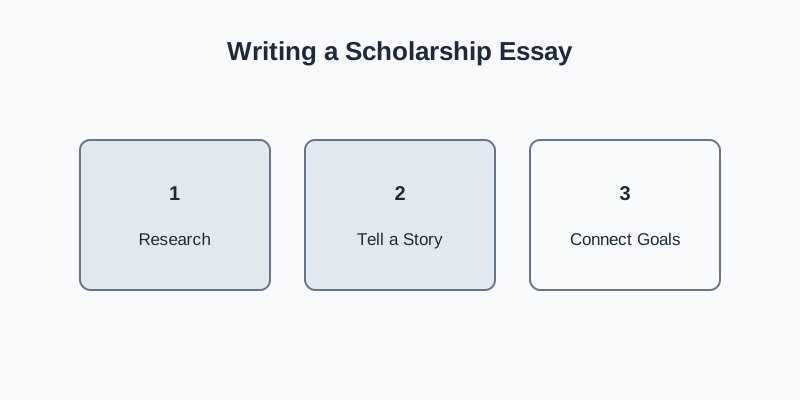
Scholarship committees often read hundreds of essays for a single award. Many of them say the same things: I am hardworking. I am passionate about helping others. This scholarship would mean so much to me. All of that may be true, but none of it helps a reader remember you.
The essays that win do something different. They tell one specific story, connect it to the funder’s mission, and make a clear case for what the money will make possible. This guide walks you through that process step by step.
What Scholarship Committees Look For
Before you write, understand your audience. Most scholarship readers are asking three questions:
- Does this student fit our mission? Every scholarship exists for a reason: to support future teachers, first-generation students, community leaders, women in engineering, and so on.
- Has this student shown the qualities we value? They want evidence, not adjectives.
- Will this money make a difference? They want to invest in someone who will use it well.
Your essay should answer all three, even if the prompt asks only one question directly.
Step 1: Analyze the Prompt and the Organization
Read the prompt slowly and underline every task word. A prompt such as “Describe a challenge you have overcome and how it has prepared you for your future career” actually asks for three things: the challenge, how you overcame it, and how it connects to your career.
Then research the organization:
- Read its mission statement and “About” page.
- Look for profiles of past recipients.
- Note any repeated words or values, such as service, innovation, resilience, or community.
Your essay doesn’t need to copy their language, but it should clearly show the qualities they care about.
Common Scholarship Prompts
- Tell us about yourself.
- Describe a challenge or setback and what you learned.
- What are your career goals, and how will this scholarship help?
- Describe your involvement in your community.
- Why do you deserve this scholarship?
- Who has influenced you most, and how?
Even the broad ones (“Tell us about yourself”) are really asking: Why should we choose you?
Step 2: Brainstorm the Right Story
The best scholarship essays focus on one specific experience that reveals your character and connects to your goals. To find it, list:
- Challenges you’ve faced and how you responded
- Moments when you took responsibility or led others
- Experiences that shaped your choice of study or career
- Times you helped someone or improved something in your community
Then choose the story that does the most work for this prompt and this organization. A story about tutoring younger students fits an education scholarship well. The same story might need a different angle for an engineering award.
Tip: Specific beats impressive. A small, vivid moment, such as the night you rebuilt a neighbor’s broken laptop so their child could do homework, is far more memorable than a list of every award you’ve won.
Step 3: Structure Your Essay
A reliable structure for most scholarship essays:
- Hook: Open with a specific moment, image, or line of dialogue that puts the reader in your story.
- Context: Briefly explain the situation or challenge.
- Action: Describe what you did. This is the heart of the essay.
- Reflection: Explain what you learned or how you changed.
- Future goals: Connect the experience to what you plan to study or do.
- The award’s role: Show how this scholarship will help you get there.
Keep the background short and spend most of your words on action and reflection. Our guide on how to write a college essay has more on opening with a strong moment.
Step 4: Show Your Qualities Through Specifics
Every scholarship applicant claims to be dedicated, hardworking, and passionate. Prove it instead.
- Telling: I am a dedicated leader who cares about my community.
- Showing: When our town’s only food pantry lost its weekend volunteers, I recruited eleven classmates, built a shared schedule, and kept it open every Saturday for the rest of the year.
The second version contains real numbers, a real problem, and a real result. The reader concludes that you’re a dedicated leader without being told.
Step 5: Connect Your Goals to the Award
Many essays forget this final step. Be concrete about what the scholarship will do for you:
- Weak: This scholarship would really help me pay for college.
- Strong: This scholarship would cover the cost of my textbooks and lab fees for two years, which means I could reduce my part-time job to weekends and join my university’s undergraduate research program in environmental engineering.
When readers can see exactly how their money will be used, it’s easier for them to choose you.
Sample Scholarship Essay Excerpt
This excerpt was written for this guide in response to the prompt: “Describe a challenge you have overcome and how it has shaped your goals.”
The first time I fixed my family’s car, I did it with a borrowed socket set and a video I paused about forty times. Our mechanic had quoted us more than my mother earned in a week, and the car was how she got to her night shifts. I was fifteen, and I had never held a torque wrench.
It took me two weekends. I made mistakes I still remember: a bolt I stripped, a hose I connected backward. But when the engine finally turned over, I understood something new. Problems that seem impossible are often just a long series of small, solvable ones.
Since then, I’ve repaired bikes for half my neighborhood and started an after-school repair club where younger students learn to diagnose problems step by step. Now I want to study mechanical engineering and design low-cost, easy-to-repair equipment for families who can’t afford to replace what breaks. This scholarship would allow me to attend full-time instead of working thirty hours a week, giving me the time to join my university’s design team and start building those solutions now.
Why it works:
- It opens with a specific, surprising moment.
- The challenge is real, but the focus stays on the student’s actions.
- The reflection (“a long series of small, solvable ones”) shows maturity.
- The ending links the story, the career goal, and the scholarship’s role.
Tips for Tone and Style
- Be honest. Don’t exaggerate hardships or achievements. Committees can tell, and many verify details.
- Stay positive. It’s fine to describe difficulties, but focus on how you responded and grew.
- Write in your own voice. Avoid overly formal language or words you wouldn’t normally use.
- Avoid clichés. Openings such as “Since I was a child…” or dictionary definitions rarely stand out.
- Respect the word limit. Going over can disqualify you. Going far under suggests you didn’t take the essay seriously.
Common Mistakes
- Not answering the prompt. Reusing an essay without adapting it is easy to spot.
- Listing achievements. Your resume or application form already shows these. Use the essay for a story.
- Focusing only on need. Even in need-based scholarships, show what you’ve done, not only what you lack.
- Forgetting the organization. If you never connect to its mission, you miss the easiest way to stand out.
- Typos and errors. A careless mistake can suggest you’ll be careless with the award. Use our proofreading and editing guide before you submit.
Scholarship Essay Checklist
- My essay answers every part of the prompt.
- I researched the organization and connected my story to its mission.
- I focus on one specific experience.
- I show my qualities through actions and details.
- I reflect on what I learned.
- I explain my goals and exactly how the award will help.
- My essay is within the word limit.
- I’ve proofread it carefully and asked someone else to read it.
Practice Exercise
Choose one scholarship you plan to apply for. Write down its mission in one sentence, then list three qualities it seems to value. Next, brainstorm one experience from your life that shows each quality. Pick the strongest one and write only the opening paragraph: start with a specific moment, not a general statement. Then write one sentence explaining exactly how the award would help you. If your opening and that final sentence connect clearly, you have the frame of a strong essay. For your conclusion, our guide on how to write a conclusion for a personal statement offers techniques that work just as well for scholarships.
Frequently Asked Questions
How long should a scholarship essay be?
Can I reuse the same essay for multiple scholarships?
Should I mention financial need in a scholarship essay?
Is a scholarship essay the same as a college application essay?
Keep Learning
How to Write a College Essay: A Step-by-Step Guide to the Personal Statement
Learn how to write a college application essay that admissions officers remember: find the right topic, structure your story, show reflection, and revise. Includes brainstorming exercises, a before-and-after example, and a checklist.
College AdmissionsHow to Start a Why Us Essay: 6 Openings Admissions Readers Remember
Learn how to start a Why Us college essay with a specific, personal opening. Includes six proven opening strategies, before-and-after examples, and the first lines to avoid.
College AdmissionsHow to Write a Conclusion for a Personal Statement (With a 4-Step Framework)
Write a personal statement conclusion that ties your story together and looks ahead. Follow a four-step framework, see full example conclusions for college and graduate school, and avoid common mistakes.