How to Narrow Down Speech Topics: 5 Methods to Go From Broad to Focused
Learn how to narrow down a speech topic using five practical methods: purpose and audience filters, the topic ladder, mind mapping, the 5 Ws, and the time test. Includes before-and-after examples and a worksheet.
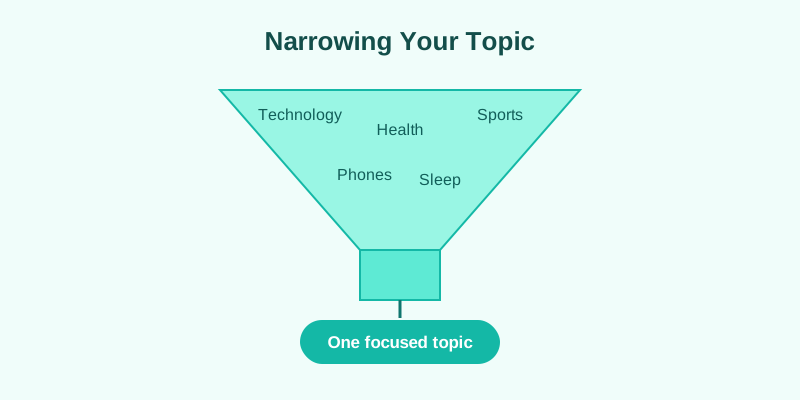
“Climate change.” “Social media.” “Sports.” These are some of the most common speech topics, and also some of the hardest to speak about well. Not because they’re bad subjects, but because they’re far too big. You can’t cover climate change in five minutes. You can explain how one city cut its energy use, or why your school should start composting.
Learning how to narrow down speech topics is one of the most useful skills in public speaking. A focused topic is easier to research, easier to organize, and much easier for your audience to remember. This guide gives you five practical methods, with examples, to go from a broad idea to a speech-ready topic.
Why Narrowing Your Topic Matters
A broad topic creates predictable problems:
- Shallow content: you skim many ideas instead of exploring a few.
- Overflowing time: you either rush or cut material at the last minute.
- Weak structure: it’s hard to choose main points when everything seems relevant.
- Forgettable message: the audience leaves without one clear takeaway.
A narrow topic solves all four. It gives you room for specific examples, stories, and evidence, which is what makes a speech interesting.
Method 1: Start With Purpose and Audience
Before narrowing, identify two things.
1. Your general purpose. Are you speaking to inform, to persuade, or to entertain? The same broad topic narrows differently for each:
| Broad topic | Inform | Persuade | Entertain |
|---|---|---|---|
| Sleep | How sleep affects memory | Why our school should start later | My nightly battle with the snooze button |
| Food | How fermentation works | Why the cafeteria should label allergens | Cooking disasters from my first apartment |
2. Your audience. What do they already know? What do they care about? A speech about budgeting for first-year college students should look very different from one for new parents.
Then write a specific purpose statement:
To inform my classmates about three ways sleep affects how well we remember what we study.
If you can write this sentence clearly, your topic is probably narrow enough. Our guide to writing a speech explains purpose statements in more detail.
Method 2: Climb Down the Topic Ladder
Write your broad topic at the top of a page, then make each line below it more specific. Keep going until you reach something you could explain in your time limit.
Example:
- Technology
- Technology in education
- Phones in schools
- Phone policies in high schools
- Whether our high school should collect phones during class
Example:
- Health
- Mental health
- Stress in students
- Exam stress
- Three study habits that reduce exam stress
The bottom of the ladder is usually your speech topic. If the bottom rung feels too narrow to fill the time, step back up one level.
Method 3: Mind Map Your Options
Write your broad topic in the center of a page and draw branches for subtopics, then smaller branches for sub-subtopics. Spend five to ten minutes without judging your ideas.
For example, from “music”:
- Music and the brain: music and memory, music while studying, why songs get stuck in your head.
- Music industry: streaming and artist pay, how songs go viral.
- Music in culture: national anthems, music at sporting events, music in your family’s traditions.
Then circle the branches that are interesting to you, relevant to your audience, and researchable. “Why songs get stuck in your head” is a focused, curious, and audience-friendly topic.
Method 4: Ask the 5 Ws
Apply who, what, where, when, and why to your broad topic. Each question can narrow it in a different direction.
Broad topic: Volunteering
- Who? Volunteering among teenagers.
- What? Volunteering at animal shelters.
- Where? Volunteer opportunities in our town.
- When? How volunteering changed during a specific period.
- Why? Why volunteering helps students build job skills.
Combining two answers often produces a strong topic: how volunteering at local animal shelters helps students build job skills.
Method 5: Apply the Time Test
Your time limit is a powerful filter. As a rough guide:
| Speech length | Typical number of main points |
|---|---|
| 2–3 minutes | 1–2 |
| 5–7 minutes | 2–3 |
| 10+ minutes | 3–4 |
List the main points your topic requires. If you need more than your time allows, narrow further. If you can’t find even two solid points, the topic may be too narrow.
Before and After: Narrowed Speech Topics
| Too broad | Narrowed |
|---|---|
| Climate change | How our city could reduce food waste in school cafeterias |
| Social media | How short-form video changes the way students study |
| Sports | Why student athletes should get rest days during exam week |
| History | How the printing press changed the way people shared news |
| Space | What astronauts eat and how space food is made |
| Money | Three budgeting habits for your first part-time job |
| Animals | How therapy dogs help hospital patients |
| Travel | What I learned from getting lost in a city where I didn’t speak the language |
Check Your Narrowed Topic
Run your topic through these questions:
- Can I state it in one sentence?
- Does it fit my general purpose (inform, persuade, or entertain)?
- Will my audience care?
- Can I cover it well in my time limit?
- Can I find credible sources or real examples?
- Am I interested in it? Your enthusiasm shows in your delivery.
If you answer “no” to any question, adjust the topic before you start researching.
Common Mistakes When Narrowing Topics
- Narrowing too late. Choosing a focus after researching a broad topic wastes time.
- Choosing a topic only because it sounds impressive. A familiar, specific topic often makes a better speech than an ambitious, vague one.
- Ignoring the audience. A topic can be narrow and still irrelevant to listeners.
- Going so narrow you can’t find information. If research turns up nothing, step back up the ladder.
- Changing topics repeatedly. Once your topic passes the checks above, commit to it.
Topic Narrowing Worksheet
Copy this into your notes and fill it in:
Broad topic:
General purpose (inform / persuade / entertain):
Audience:
Time limit:

Topic ladder:
  1.
  2.
  3.
  4.
  5.

Narrowed topic:
Specific purpose statement:
  To ______ my audience about / that ______.

Two to three main points:
  1.
  2.
  3.
Practice Exercise
Pick three broad topics from this list: food, technology, friendship, the environment, or school. For each, use a different method (topic ladder, mind map, and 5 Ws) to narrow it down. Write a specific purpose statement for each result, then choose the one you’d be most excited to research. Once you have your topic, see our informative speech guide for 40 more topic ideas, or practice thinking quickly with our impromptu speech topics.
Frequently Asked Questions
Why is it important to narrow down a speech topic?
How do I know if my speech topic is too broad?
Can a speech topic be too narrow?
What is the difference between a general purpose and a specific purpose?
Keep Learning
What Is an Entertainment Speech? How to Make One Your Audience Enjoys
Learn what an entertainment speech is, its types and purpose, and how to make one step by step: choosing a theme, building a structure, adding humor and stories, and delivering it well. Includes topic ideas and a sample outline.
Speech WritingHow to Write a Manuscript Speech That Doesn't Sound Read
Learn how to write and deliver a manuscript speech: when to use one, how to write a script for the ear, how to format and mark the pages, and how to practice so reading word for word still sounds natural.
Speech WritingWhat Is a Prepared Speech? Types, Examples, and How to Prepare One
Learn what a prepared speech is, how it differs from an impromptu speech, the three types of prepared delivery (manuscript, memorized, and extemporaneous), and a step-by-step method to prepare your own.