How to Write a Manuscript Speech That Doesn't Sound Read
Learn how to write and deliver a manuscript speech: when to use one, how to write a script for the ear, how to format and mark the pages, and how to practice so reading word for word still sounds natural.
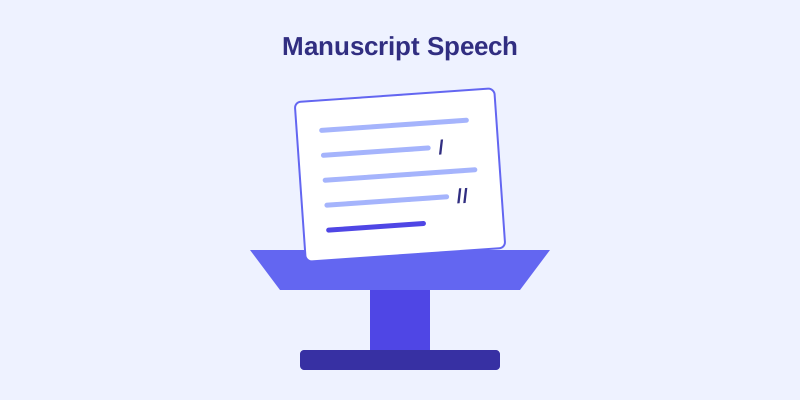
Most speaking advice says, “Don’t read your speech.” But sometimes reading is exactly the right choice. When every word matters, when you’re speaking on the record, or when you’re too emotional to trust your memory, a full script keeps you accurate. The challenge is making a written page sound like a person talking.
That’s the art of the manuscript speech. This guide explains when to use one, how to write a script designed to be heard rather than read, how to format the pages for easy delivery, and how to practice until the audience forgets you’re holding paper.
What Is a Manuscript Speech?
A manuscript speech is a speech delivered by reading a complete, word-for-word script. The script might be printed on paper, displayed on a tablet, or shown on a teleprompter.
It’s one of the four classic methods of speech delivery:
| Method | How it’s delivered | Best for |
|---|---|---|
| Manuscript | Read from a full script | Exact wording, formal or official occasions |
| Memorized | Full script, learned by heart | Short ceremonial speeches, competitions |
| Extemporaneous | Prepared and rehearsed, delivered from brief notes | Most classroom and professional presentations |
| Impromptu | Little or no preparation | Unexpected questions, meetings, toasts |
If you’d like to compare manuscript speaking with the other planned methods, see our guide to what a prepared speech is.
When Should You Use a Manuscript Speech?
A manuscript speech is a good choice when:
- Precision matters. Official statements, policy announcements, legal or organizational statements, and press briefings where a misplaced word could cause problems.
- The speech will be published or recorded. The written text and the spoken version should match.
- Timing is strict. Broadcasts and ceremonies with tight schedules.
- Emotions run high. Eulogies and tributes, where a script helps you get through difficult moments.
- Your instructor assigns it. Many public speaking courses include a manuscript speech assignment to practice this specific skill.
For most other speeches, an extemporaneous style (prepared, but delivered from notes) creates a stronger connection with the audience.
Step 1: Plan Before You Script
Don’t start by writing sentences. Start the way you would for any speech:
- Define your purpose: what should the audience know, feel, or do afterward?
- Analyze your audience: what do they already know, and what do they care about?
- Choose two to four main points.
- Make an outline with your introduction, main points, support, and conclusion.
Our step-by-step guide to writing a speech covers this planning stage in detail. Once your outline is solid, you’re ready to write the manuscript.
Step 2: Calculate Your Word Count
A script lets you control timing precisely. Many speakers read aloud at roughly 120 to 160 words per minute, which gives a rough guide:
| Speaking time | Approximate word count |
|---|---|
| 2 minutes | 240–320 words |
| 5 minutes | 600–800 words |
| 10 minutes | 1,200–1,600 words |
Your own pace may differ, so read a paragraph aloud with a timer and adjust. Remember that pauses, applause, and laughter add time.
Step 3: Write for the Ear, Not the Eye
This is the most important step. A manuscript speech is written down, but the audience only hears it. Listeners can’t reread a sentence they missed, so your script needs to work differently from an essay.
Use shorter sentences
Long, complex sentences are hard to read aloud and hard to follow.
- Essay style: Although the committee, which met three times over the spring, considered several proposals, it ultimately recommended the option that offered the greatest long-term savings.
- Speech style: The committee met three times this spring. It looked at several proposals. In the end, it chose the one that saves the most money over time.
Use conversational language
Write the way you speak. Contractions (we’re, it’s, don’t) sound natural. Replace formal words with everyday ones where possible: use instead of utilize, help instead of facilitate.
Repeat key ideas
In writing, repetition can feel redundant. In speech, it helps the audience remember. Repeat your central message in the introduction, between main points, and in the conclusion.
Use signposts
Tell listeners where they are in the speech:
- “I have three reasons. Here’s the first.”
- “That brings me to my second point.”
- “So what does all of this mean for us?”
Use rhythm and rhetorical devices
Devices such as the rule of three, parallelism, and antithesis make spoken language memorable. See 20 rhetorical devices every writer and speaker should know for examples.
Read every line aloud as you write
If you stumble over a sentence, rewrite it. If you run out of breath, split it. Watch for tongue twisters and awkward sound combinations that look fine on paper.
Step 4: Format the Manuscript for Delivery
A delivery script should be designed for quick glances, not careful reading. Many speakers use these formatting habits:
- Large font: 14 to 18 point is easier to read at arm’s length than standard 12 point.
- Generous spacing: 1.5 or double spacing, with wide margins.
- Short paragraphs: one idea per paragraph, with space between them.
- Don’t split sentences across pages. End every page at the end of a sentence or paragraph.
- Number the pages in large type at the top.
- Use only the top two-thirds of each page so your eyes don’t drop too far down, which pulls your head away from the audience.
- Print single-sided and don’t staple. Slide each finished page to the side quietly instead of flipping it.
If you’re using a tablet, disable notifications and auto-lock, increase the font size, and keep a printed backup.
Step 5: Mark Up Your Script
Once your text is final, add delivery marks. These turn a written document into a performance script. Common marks include:
- A slash ( / ) for a short pause; a double slash ( // ) for a longer one.
- Underline or bold for words you want to emphasize.
- Arrows to remind you to slow down or raise your voice.
- Margin notes such as “look up,” “smile,” or “gesture to slide.”
Example:
Three years ago, / this program served forty families. // Today, / it serves more than two hundred. // And next year, / with your help, / we can double that.
These marks support the vocal variety you need to keep a read speech interesting. Our guide to modulation in speech explains how to vary pitch, pace, volume, and pauses.
Step 6: Practice Until You Know It Almost by Heart
The goal is not memorization, but familiarity. When you know the script well, you only need to glance down to catch the next phrase, then look up to deliver it.
- Read silently to check the flow.
- Read aloud several times, following your delivery marks.
- Practice the “glance and deliver” technique: look down, take in a phrase, look up, say it to the audience, and repeat.
- Make eye contact at the ends of sentences and at key points, which is when it matters most.
- Record yourself and listen for sections that sound flat or rushed.
- Rehearse with your real setup: the actual pages, the actual lectern or tablet, standing up.
Step 7: Deliver With Presence
On the day:
- Arrive early and check that your pages are in order.
- Look up for your opening line. If possible, learn the first and last sentences by heart so you begin and end with eye contact.
- Keep your finger or eye on your place so you can find it quickly after looking up.
- Use natural gestures with the hand that isn’t holding a page.
- Don’t apologize for reading. Delivered confidently, a manuscript speech is a professional choice.
- If you lose your place, pause calmly, find the line, and continue. A short silence feels much longer to you than to the audience.
Common Manuscript Speech Mistakes
- Writing an essay and reading it aloud. Long sentences and formal vocabulary make the speech hard to follow.
- Keeping your head down. The audience connects with your face, not the top of your head.
- Reading in a monotone. Without vocal variety, even great writing sounds dull.
- Rushing. Nervous readers tend to speed up. Your pause marks are there to slow you down.
- Last-minute rewriting. Changes the night before can break the familiarity you’ve built through practice.
Manuscript Speech Checklist
- Is the speech planned from a clear purpose and outline?
- Does the word count fit the time limit?
- Are sentences short and conversational?
- Have I used signposts and repetition?
- Is the script formatted in large type with generous spacing?
- Are pause and emphasis marks added?
- Have I practiced the “glance and deliver” technique aloud?
- Do I know my first and last lines by heart?
Practice Exercise
Take one paragraph from an essay you’ve written. Rewrite it as a manuscript speech passage: shorten the sentences, add a signpost, and use conversational language. Then format it in 16-point type, add pause and emphasis marks, and read it aloud three times, looking up at the end of every sentence. Record the third reading and compare it with how the original essay paragraph sounds read aloud. For delivery habits that help with any speech, see our public speaking tips.
Frequently Asked Questions
What is a manuscript speech?
What is the difference between a manuscript speech and a memorized speech?
What are the disadvantages of a manuscript speech?
How many words is a five-minute manuscript speech?
Keep Learning
What Is an Entertainment Speech? How to Make One Your Audience Enjoys
Learn what an entertainment speech is, its types and purpose, and how to make one step by step: choosing a theme, building a structure, adding humor and stories, and delivering it well. Includes topic ideas and a sample outline.
Speech WritingHow to Narrow Down Speech Topics: 5 Methods to Go From Broad to Focused
Learn how to narrow down a speech topic using five practical methods: purpose and audience filters, the topic ladder, mind mapping, the 5 Ws, and the time test. Includes before-and-after examples and a worksheet.
Speech WritingWhat Is a Prepared Speech? Types, Examples, and How to Prepare One
Learn what a prepared speech is, how it differs from an impromptu speech, the three types of prepared delivery (manuscript, memorized, and extemporaneous), and a step-by-step method to prepare your own.