How to Write a Speech: A Step-by-Step Guide With a Sample Outline
Learn how to write a speech that works out loud: define your purpose, analyze your audience, structure your points, write for the ear, and time your draft.
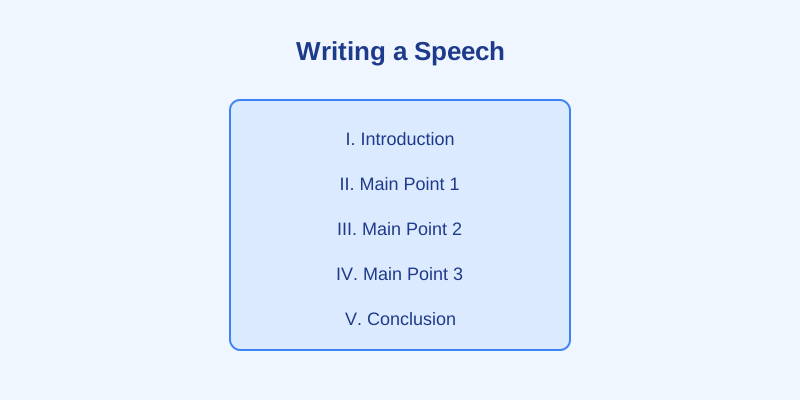
Writing a speech is not the same as writing an essay. An essay is read at the reader’s pace: they can reread a confusing sentence, skim a familiar point, or flip back to check a definition. A speech is heard once, at your pace, in order. Everything about how you write it should follow from that difference.
This guide takes you from a blank page to a finished, timed speech in seven steps, using a sample speech on a common school topic so you can see each step in action.
Step 1: Define Your Purpose
Every speech has a general purpose and a specific purpose.
General purposes fall into three broad types:
- To inform: explain a topic, process, or idea (e.g. “how vaccines train the immune system”)
- To persuade: change beliefs or prompt action (e.g. “our school should adopt a later start time”)
- To entertain or commemorate: mark an occasion, celebrate, or move the audience (e.g. a graduation speech, a toast, a eulogy)
Your specific purpose names exactly what the audience should know, believe, or do by the end:
General purpose: to persuade Specific purpose: to persuade my classmates to volunteer for at least one community project this term
Then write a central idea, a single sentence that sums up the whole speech:
Central idea: Volunteering builds practical skills, connects you with your community, and is easier to start than most students think.
That sentence is your compass. Anything in your draft that doesn’t serve it should be cut.
Step 2: Analyze Your Audience
The same topic needs a different speech for a different audience. Ask:
- Who are they? Age, background, what they already know about the topic
- Why are they here? Required to attend, or chose to come?
- What do they care about? What objections or doubts might they have?
- What is the setting? How long do you have? Is there a microphone, screen, or lectern?
For our sample speech, the audience is classmates aged 15–17. They are busy, may see volunteering as a chore, and probably don’t know how to find opportunities. That tells us to emphasize benefits to them, keep it practical, and remove barriers.
Step 3: Choose Two to Four Main Points
Listeners can’t hold many ideas at once. Most speeches under ten minutes work best with two to four main points; three is a natural default.
Brainstorm everything you could say, then group related ideas and choose the strongest. Main points should be:
- Distinct, without overlap between them
- Balanced, with roughly equal time and weight
- Clearly connected to the central idea
Common patterns for organizing main points:
| Pattern | Best for | Example |
|---|---|---|
| Topical | Informative speeches | Three types of renewable energy |
| Chronological | Histories, processes | The life of a project from idea to launch |
| Problem–solution | Persuasive speeches | Food waste in our cafeteria → a composting program |
| Cause–effect | Explaining why | Why sleep loss affects memory |
| Monroe’s Motivated Sequence | Calls to action | Attention → need → satisfaction → visualization → action |
Our sample uses a topical structure:
- Volunteering builds skills you can’t get in a classroom.
- It connects you with people and your community.
- Getting started is easier than you think.
Step 4: Develop Each Point With Support
Each main point needs evidence and examples. Good supporting material includes:
- Examples and stories, the most memorable form of support
- Statistics, which work best when rounded and explained (“about one in four” rather than “24.7%”)
- Expert testimony or quotations
- Comparisons and analogies, which link the unfamiliar to the familiar
For spoken delivery, prefer one vivid example over three dry statistics. If you do use numbers, put them in context: “That’s enough to fill this auditorium twice.”
Sample development of point 1:
Last summer, my friend Priya started helping at the food bank on Saturday mornings. Within a month she was coordinating twelve other volunteers, which meant scheduling, solving problems on the spot, and talking to strangers every week. Those are exactly the skills employers and universities say they look for, and you won’t learn them from a textbook.
Step 5: Write the Introduction and Conclusion
Write these after the body, once you know exactly what you are introducing and concluding.
The introduction (about 10–15% of your time)
A strong introduction does four things:
- Gets attention: a story, question, surprising fact, or quotation
- Reveals the topic: makes clear what you’ll talk about
- Establishes credibility: why you are a good person to speak on this
- Previews the main points: tells listeners the roadmap
How many hours did you spend on your phone last week? Now imagine giving just two of those hours to something that could change your summer, and maybe your future. I’m [Name], and for the past year I’ve volunteered at the community garden on Elm Street. Today I want to show you three things: the skills volunteering builds, the connections it creates, and how easy it is to get started.
The conclusion (about 5–10% of your time)
- Signal the end: “So, as we wrap up…”
- Summarize the main points
- End with a memorable close: a call to action, a callback to your opening, or a striking final line
So: volunteering builds skills, it connects you with your community, and starting is easier than you think. Remember those hours on your phone? This week, trade just two of them. Pick one opportunity from the list I’m handing out, and sign up before Friday. Your future self will thank you.
The callback to the opening question gives the speech a satisfying sense of closure.
Step 6: Write for the Ear, Not the Eye
This is the step most speechwriters skip, and it makes the biggest difference. Once you have a draft, revise it for listening:
- Use short sentences. Long sentences with multiple clauses are hard to follow aloud. Break them up.
- Use simple, concrete words. “Use” instead of “utilize”; “help” instead of “facilitate.”
- Add signposts. “My first point is…” / “Now that we’ve seen the problem, let’s look at the solution.” These feel repetitive on paper but are essential for listeners.
- Repeat key phrases. Repetition helps an audience remember. Many famous speeches are built around a repeated phrase.
- Use the rule of three. Lists of three (“skills, connections, and confidence”) sound complete and are easy to remember.
- Use “you” and “we.” Direct address keeps the audience involved.
- Read it aloud. Anywhere you stumble, rewrite.
Before (written style):
Participation in volunteer activities has been demonstrated to contribute to the development of a range of transferable competencies that are valued by prospective employers.
After (spoken style):
Volunteering teaches you real skills. The kind employers look for. Leadership. Problem-solving. Talking to people you’ve never met.
Step 7: Time It and Make Speaking Notes
Most people speak at roughly 120–160 words per minute in a presentation. As a rough guide:
| Speech length | Approximate word count |
|---|---|
| 2 minutes | 250–300 words |
| 5 minutes | 650–750 words |
| 10 minutes | 1,300–1,500 words |
Time yourself reading aloud at a natural pace, including pauses. If you’re over, cut. Don’t plan to speak faster. Nerves usually speed you up anyway, but pauses and audience reactions add time.
Finally, convert your script into speaking notes: keywords, your opening and closing lines written out in full, and transitions. Delivering from notes rather than a full script helps you sound natural and keep eye contact. If the occasion calls for exact wording, learn how to write a manuscript speech, or compare all three methods in what is a prepared speech.
Sample Speech Outline
Title: Two Hours That Could Change Your Year Specific purpose: To persuade classmates to volunteer for at least one project this term Central idea: Volunteering builds skills, creates connections, and is easy to start.
I. Introduction
- A. Attention: “How many hours did you spend on your phone last week?”
- B. Topic and credibility: a year volunteering at the community garden
- C. Preview: skills, connections, getting started
II. Body
- A. Volunteering builds skills
-
- Example: Priya at the food bank, coordinating twelve volunteers
-
- Skills employers and universities value
-
- B. Volunteering creates connections
-
- Meeting people outside your usual circle
-
- Story: a mentor I met at the garden
-
- C. Getting started is easy
-
- Three local organizations that welcome teens
-
- Even two hours a week makes a difference
-
III. Conclusion
- A. Summary of three points
- B. Call to action: sign up before Friday
- C. Callback: trade two hours of screen time
Final Checklist
- I can state my central idea in one sentence.
- I have two to four distinct, balanced main points.
- Each point has at least one concrete example or story.
- My introduction gets attention, reveals the topic, builds credibility, and previews.
- My conclusion summarizes and ends memorably.
- I’ve revised for the ear: short sentences, signposts, plain words.
- I’ve timed it aloud and it fits.
Once your speech is written, the next step is delivery. Read our public speaking tips for help with voice, eye contact, and body language.
Keep Learning
What Is an Entertainment Speech? How to Make One Your Audience Enjoys
Learn what an entertainment speech is, its types and purpose, and how to make one step by step: choosing a theme, building a structure, adding humor and stories, and delivering it well. Includes topic ideas and a sample outline.
Speech WritingHow to Narrow Down Speech Topics: 5 Methods to Go From Broad to Focused
Learn how to narrow down a speech topic using five practical methods: purpose and audience filters, the topic ladder, mind mapping, the 5 Ws, and the time test. Includes before-and-after examples and a worksheet.
Speech WritingHow to Write a Manuscript Speech That Doesn't Sound Read
Learn how to write and deliver a manuscript speech: when to use one, how to write a script for the ear, how to format and mark the pages, and how to practice so reading word for word still sounds natural.