How to Write a Compare and Contrast Essay: Methods, Outlines, and Examples
Learn the block and point-by-point methods for compare and contrast essays, how to write a thesis that goes beyond 'they are similar and different,' and outlines you can adapt.
A compare and contrast essay examines two (or occasionally more) subjects to show how they are similar, how they are different, or both. It might compare two novels, two historical leaders, two scientific theories, two cities, or two solutions to a problem.
The trap with this essay type is producing a list: “Here are five similarities and five differences.” A strong compare and contrast essay does something more: it uses the comparison to reveal an insight you wouldn’t see by looking at either subject alone.
Step 1: Choose Subjects That Can Be Meaningfully Compared
Your subjects need a basis for comparison, something they have in common that makes comparing them worthwhile.
- Too similar: two nearly identical smartphone models (there’s little to say)
- Too different: a novel and a volcano (there’s no meaningful connection)
- Just right: two novels about the same war, two approaches to teaching reading, two cities’ public transport systems
Often, the most interesting comparisons involve:
- Two subjects that seem similar but differ in important ways
- Two subjects that seem different but share a surprising connection
Step 2: Brainstorm With a Venn Diagram or Table
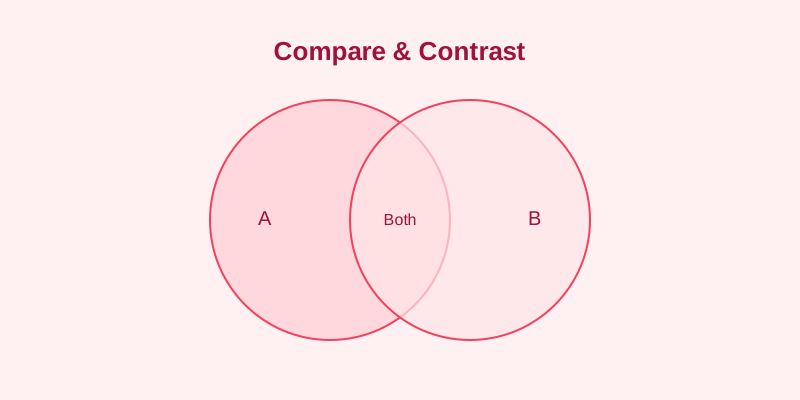
Before you write, map out similarities and differences. A Venn diagram works well: two overlapping circles, with shared features in the middle.
A comparison table is even more useful because it forces you to compare the same criteria for both subjects:
Example: Online learning vs. in-person learning
| Criterion | Online learning | In-person learning |
|---|---|---|
| Flexibility | Study anytime, anywhere | Fixed schedule and location |
| Social interaction | Mostly through screens | Face-to-face with classmates and teachers |
| Self-discipline needed | High | Moderate; structure is external |
| Access | Requires device and internet | Requires travel to a campus |
| Feedback | Often delayed or written | Immediate and conversational |
| Cost | Often lower | Often higher (commuting, housing) |
Now you can see patterns. Which differences matter most? For whom?
Step 3: Write a Thesis That Makes a Point
The weakest compare and contrast thesis simply states that similarities and differences exist:
❌ Online learning and in-person learning have many similarities and differences.
That’s true of any two things. A strong thesis tells the reader what the comparison reveals:
✅ While online learning offers flexibility that in-person classes cannot match, in-person learning remains more effective for most secondary-school students, because they depend on the structure, immediate feedback, and social connection that a physical classroom provides.
Other strong thesis patterns:
- “Although X and Y appear similar, they differ in a crucial way…”
- “Despite their obvious differences, X and Y share…”
- “Comparing X and Y shows that…”
For more on writing focused claims, see how to write a strong thesis statement.
Step 4: Choose an Organizational Method
There are two main ways to organize a compare and contrast essay.
Method 1: Block (subject-by-subject)
Discuss everything about Subject A, then everything about Subject B.
Outline:
- Introduction and thesis
- Subject A: flexibility, social interaction, feedback
- Subject B: flexibility, social interaction, feedback
- Conclusion: what the comparison reveals
Pros: easy to write; works well for short essays and when the subjects are less directly comparable. Cons: the reader must remember all of Subject A while reading about B, and the essay can feel like two separate mini-essays. The comparison often only happens in the conclusion.
Tip: if you use the block method, make the second block explicitly refer back to the first: “Unlike online learning, in-person classes provide…”
Method 2: Point-by-point (alternating)
Organize by criterion, discussing both subjects within each paragraph.
Outline:
- Introduction and thesis
- Flexibility: online vs. in-person
- Social interaction: online vs. in-person
- Feedback: online vs. in-person
- Conclusion: what the comparison reveals
Pros: keeps the comparison front and center throughout; easier for the reader to follow; better for longer essays and detailed analysis. Cons: can feel repetitive if every paragraph follows exactly the same pattern.
Most teachers prefer the point-by-point method for essays longer than about 1,000 words, because it keeps the analysis comparative throughout.
A hybrid option
You can also start with a paragraph on similarities, then move point-by-point through the differences (or the reverse). This is useful when the similarities are brief and the differences are where your argument lies.
Step 5: Write Comparative Body Paragraphs
Here is a point-by-point paragraph in action:
[Topic sentence] The most significant difference between the two formats is the speed of feedback. [Subject A] In a physical classroom, a confused student can raise a hand and receive an answer within seconds, and a teacher can read puzzled faces and re-explain before misunderstandings take root. [Subject B] Online, by contrast, feedback often arrives as written comments days after an assignment is submitted, by which time the student may have repeated the same error several times. [Analysis] For younger students, who are still learning how to identify and articulate their own confusion, this delay can turn a small misunderstanding into a lasting gap. [Link to thesis] This is one of the clearest reasons in-person learning remains more effective for this age group.
Notice that the paragraph doesn’t just describe both subjects. It analyzes why the difference matters.
Useful comparison and contrast language
To show similarity: similarly, likewise, in the same way, both, just as, equally, also, share, have in common
To show difference: however, in contrast, on the other hand, whereas, while, unlike, conversely, differs from, by comparison
Whereas online courses allow students to set their own pace, in-person classes move everyone forward together. Unlike the novel, the film adaptation opens with the final scene.
See our full list of transition words for essays for more.
Step 6: Write a Conclusion That Shows the Insight
Don’t end with “In conclusion, X and Y have many similarities and differences.” Instead, explain what the comparison as a whole has revealed:
Online and in-person learning will both play a role in the future of education. But comparing them side by side shows that flexibility, while valuable, cannot replace the structure, immediate feedback, and human connection that younger students depend on. The question is not which format is better in general, but which is better for whom, and for most secondary-school students, the answer is still the classroom.
For more strategies, read how to write a conclusion.
Example Topics
Literature and film
- Two characters from the same novel (e.g. Elizabeth and Jane Bennet in Pride and Prejudice)
- A novel and its film adaptation
- Two poems on the same theme
- The hero in a classical epic vs. a modern superhero film
History and society
- Two historical leaders’ approaches to the same crisis
- Two revolutions (e.g. the American and French Revolutions)
- Urban vs. rural life
- Two countries’ approaches to healthcare or education
Science and technology
- Renewable vs. fossil-fuel energy sources
- Two theories explaining the same phenomenon
- E-books vs. printed books
- Electric vs. petrol cars
Everyday life
- Two approaches to studying (e.g. cramming vs. spaced practice)
- Working from home vs. working in an office
- Team sports vs. individual sports
- Two different ways of learning a language
Common Mistakes
- Listing without analyzing. Every similarity or difference should connect to your thesis.
- Imbalance. Spending three paragraphs on Subject A and one on Subject B. Give both fair treatment, even if your thesis favors one.
- Inconsistent criteria. If you discuss Subject A’s cost, discuss Subject B’s cost too.
- A “so what?” gap. If your conclusion just repeats that the subjects are similar and different, you haven’t shown the insight.
- Comparing too many things. Two subjects compared in depth is better than four compared superficially.
Compare and Contrast Checklist
- My subjects share a clear basis for comparison.
- I brainstormed using the same criteria for both subjects.
- My thesis states what the comparison reveals, not just that differences exist.
- I chose block, point-by-point, or hybrid organization deliberately.
- Each body paragraph analyzes why a similarity or difference matters.
- I use clear comparison and contrast transitions.
- My conclusion explains the insight the comparison provides.
Practice Exercise
Choose two methods of studying: rereading notes and testing yourself with practice questions. Create a comparison table using at least four criteria (for example: time required, effort, how it feels, and how well you remember the material a week later). Then write a thesis that states what the comparison reveals. Hint: learning research has repeatedly found that self-testing, often called “retrieval practice,” tends to produce better long-term retention than rereading, even though rereading often feels more productive.
Keep Learning
How to Do a Literacy Essay: Write a Literacy Narrative Readers Connect With
A step-by-step guide to writing a literacy essay (literacy narrative): choosing a meaningful moment, structuring your story, reflecting on what it means, plus an original example and topic ideas.
Essay WritingWhat Is a Great Thesis Statement? 7 Tests That Separate Good From Great
What makes a thesis statement great, not just correct? Use seven simple tests to evaluate and upgrade your thesis, with before-and-after examples showing how average claims become memorable ones.
Essay WritingHow Do You Write an Essay Outline? A 5-Step Method With Templates
Learn how to write an essay outline in five steps, with free templates for five-paragraph, argumentative, and compare-and-contrast essays, plus a filled-in example and tips for turning your outline into a draft.