 Javed Ali • • 6 min read • Research & Citation
How to Write an Annotated Bibliography: Format, Steps, and Examples
Learn how to write an annotated bibliography step by step: choosing sources, writing descriptive, evaluative, and reflective annotations, and formatting entries in MLA and APA style. Includes sample annotations and a checklist.
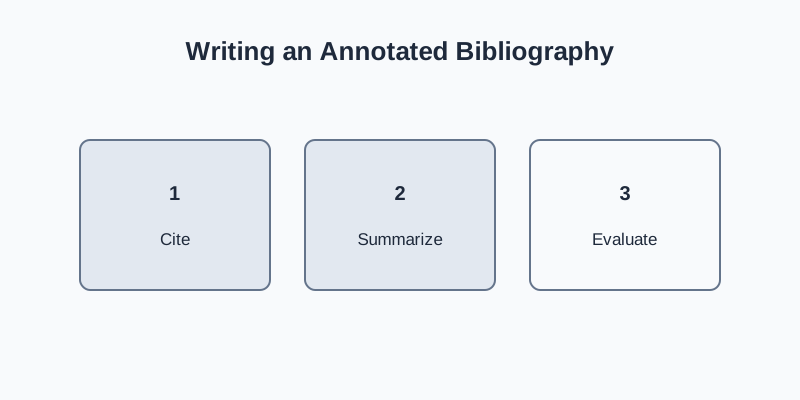
An annotated bibliography sounds like busywork until you’re halfway through a research paper and can’t remember which source said what. Then it becomes the most useful document you own.
It’s also one of the most common assignments in high school and college research courses, because it shows your instructor that you’ve actually read your sources and thought about them. This guide explains what an annotated bibliography is, how to write each annotation, and how to format the whole thing.
What Is an Annotated Bibliography?
An annotated bibliography is a list of sources, each followed by a short paragraph (the annotation) that summarizes and often evaluates the source.
Each entry has two parts:
- The citation, formatted in the style your course uses, such as MLA or APA.
- The annotation, usually 100 to 200 words, written in your own words.
It helps you in three ways:
- It forces you to read sources closely instead of skimming.
- It shows you whether you have enough evidence, and where the gaps are.
- It gives you a ready-made map of your research when you start writing.
Three Types of Annotations
Before you write, check which type your instructor wants. Many assignments ask for a combination.
| Type | What it does | Key question |
|---|---|---|
| Descriptive (summary) | Explains what the source covers and argues | What does it say? |
| Evaluative (critical) | Judges the source’s strengths, weaknesses, and reliability | How good is it? |
| Reflective | Explains how the source fits your own research | How will I use it? |
A complete annotation for a college course usually does all three in one paragraph: two or three sentences of summary, two of evaluation, and one or two of reflection.
Step 1: Find and Choose Your Sources
Start with your research question. If you don’t have one yet, our guide on how to write a thesis statement can help you narrow a topic.
Look for sources that are:
- Relevant: they address your question directly, not just your general topic.
- Credible: written by qualified authors and published by reputable outlets, such as academic journals, university presses, or established news organizations.
- Current enough: recent research matters more in fast-moving fields like medicine or technology than in history or literature.
- Varied: a mix of perspectives, including at least one that challenges your view.
Your assignment will usually say how many sources you need. Gather a few extra so you can drop the weakest.
Step 2: Read Actively and Take Notes
For each source, note:
- The author’s main argument or purpose
- The methods or kind of evidence used
- The key findings or conclusions
- The author’s credentials and any possible bias
- How the source compares with your other sources
- How you might use it in your paper
Write these notes in your own words. That makes the annotation easier to write and protects you from accidental plagiarism. If you’re not sure how to restate an idea without copying, read our guide on how to paraphrase and avoid plagiarism.
Step 3: Write the Citation
Format each citation exactly as it would appear in a works cited or reference list. Our MLA and APA citation guide shows the basic patterns for books, articles, and websites.
Getting the citation right first also forces you to collect all the source details you’ll need later.
Step 4: Write the Annotation
A reliable structure for a full annotation:
- Summarize the main argument in one or two sentences.
- Describe the method or evidence briefly.
- Evaluate the source: its strengths, limitations, and credibility.
- Reflect on how it relates to your research or other sources.
Use strong, precise verbs to describe what the author does: argues, examines, compares, challenges, demonstrates, surveys, proposes, concludes. Avoid vague openings such as “This article is about…”
Sample Annotations
The sources below are fictional and were created for this guide to show the structure clearly. In your own work, use real sources and verify every detail.
Example 1 (MLA style, descriptive and evaluative):
Rivera, Elena. Quiet Rooms: Public Libraries in the Digital Age. Harbor Press, 2021.
Rivera argues that public libraries have shifted from book lenders to community technology centers. Drawing on interviews with librarians in twelve mid-sized cities, she shows that internet access, job-search help, and digital skills classes now account for much of libraries’ daily use. The book’s strength is its first-hand detail from staff and patrons, though its focus on mid-sized cities means it says little about rural libraries, where access gaps may be greatest. Rivera’s interviews will support my argument that library funding is a form of economic infrastructure, while I will need another source to address rural communities.
Example 2 (APA style, evaluative and reflective):
Chen, M., & Okafor, D. (2022). Handwritten versus typed notes and long-term recall in first-year university students. Journal of Learning Practice, 14(3), 45–61.
Chen and Okafor compare the exam performance of 240 first-year students who took notes by hand or on laptops during the same lectures. Students who handwrote notes scored modestly higher on conceptual questions a week later, though the groups performed similarly on factual recall. The study is useful because it separates types of learning, but its participants came from a single university, which limits how far the findings can be generalized. This source gives my paper a balanced counterpoint: it supports handwriting for conceptual learning while showing the effect is smaller than popular articles suggest.
Notice what both examples do: they summarize the argument, mention the evidence, name a specific strength and limitation, and end with a clear statement of how the source will be used.
How to Format an Annotated Bibliography
MLA Style
- Title the page Annotated Bibliography, centered.
- List entries alphabetically by author’s last name.
- Use a hanging indent for the citation and double-space the whole document.
- Begin the annotation on the line after the citation, indented beneath it.
APA Style
- Title the page Annotated Bibliography, bold and centered.
- List entries alphabetically by first author’s last name.
- Use a hanging indent for each reference and double-space throughout.
- Place the annotation on a new line below the reference, indented as a block.
Exact indentation and title rules can vary by edition and by instructor, so always check the assignment sheet or the latest official style guide if a detail matters for your grade.
Common Mistakes
- Copying the abstract. Your annotation must be in your own words. Instructors can easily spot a pasted abstract.
- Only summarizing when evaluation is required. If the assignment says “critical” or “evaluative,” you must judge the source, not just describe it.
- Vague evaluation. “This is a good source” says nothing. Explain why: the sample size, the author’s expertise, the date, the evidence.
- Inconsistent formatting. Mixing MLA and APA, or forgetting hanging indents, costs easy points.
- Wrong order. Unless told otherwise, list entries alphabetically.
Annotated Bibliography Checklist
- I’ve used the number and types of sources the assignment requires.
- Every citation follows one style consistently.
- Entries are in alphabetical order.
- Each annotation is in my own words.
- Each annotation summarizes the source’s main argument.
- Each annotation includes evaluation, if required.
- Each annotation explains how the source fits my research, if required.
- Annotations meet the length guideline.
- The document is double-spaced with hanging indents.
Practice Exercise
Pick one source you’ve already found for a current project. In one sentence, write its main argument using a strong verb such as argues or demonstrates. In a second sentence, describe its evidence. In a third, name one strength and one limitation. In a fourth, explain exactly where it will appear in your paper. Those four sentences are a complete annotation. Repeat the process for each source, then use the finished bibliography to build your essay outline.
Frequently Asked Questions
How long should an annotation be?
What is the difference between a bibliography and an annotated bibliography?
Should an annotated bibliography be in alphabetical order?
Can I use first person in an annotated bibliography?
Keep Learning
How to Paraphrase and Avoid Plagiarism: A Step-by-Step Guide With Examples
Learn how to paraphrase a source in your own words without plagiarizing: a five-step method, side-by-side examples of bad and good paraphrases, when to quote or summarize instead, and a checklist for citing borrowed ideas correctly.
Research & CitationHow to Cite Sources in MLA and APA Style: A Beginner's Guide
Learn when to cite, how in-text citations and reference lists work, and the MLA 9th edition and APA 7th edition formats for books, journal articles, and websites.
Speech WritingHow to Write a Graduation Speech: Structure, Tips, and a Sample Speech
Learn how to write and deliver a memorable graduation speech, whether you're the valedictorian, class president, or guest speaker. Covers choosing a theme, structure, humor, timing, and delivery, with a sample speech and an outline.