What Is Modulation in Speech? 5 Elements of Vocal Variety (With Exercises)
Learn what voice modulation in speech means, why it matters, and how to use its five elements: pitch, pace, volume, tone, and pauses. Includes marked examples and practice exercises to stop sounding monotone.
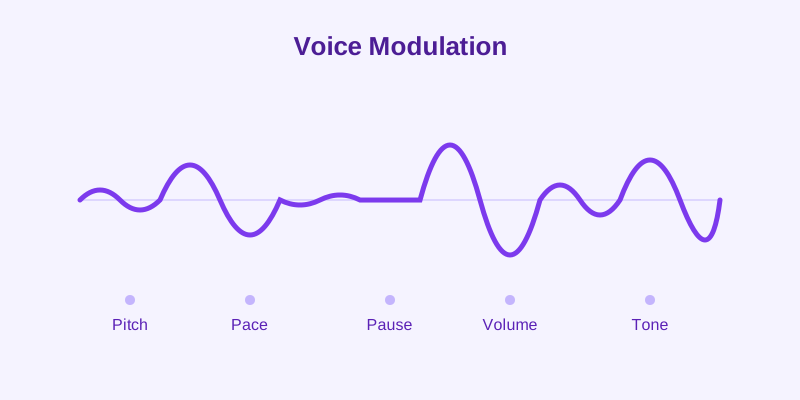
Two speakers can say exactly the same words and leave completely different impressions. One sounds confident and engaging; the other sounds flat, rushed, or uncertain. Often the difference isn’t the script. It’s the voice.
That difference is modulation. This guide explains what modulation in speech is, breaks it into five elements you can practice, and gives you exercises to make your voice more expressive, whether you’re giving a class presentation, a toast, or a speech to a large audience.
What Is Modulation in Speech?
Modulation in speech is the deliberate variation of your voice to express meaning, show emotion, and hold your listeners’ attention. It’s also called vocal variety.
Instead of speaking every word at the same pitch, speed, and volume, a speaker who uses modulation adjusts their voice to match what they’re saying. Important ideas sound important. Exciting moments sound exciting. Serious moments sound serious.
The opposite of modulation is a monotone: a voice that stays at one level, which makes it hard for listeners to tell which ideas matter most.
Why Modulation Matters
- It clarifies meaning. Emphasis tells listeners which words carry the message.
- It holds attention. Changes in sound naturally draw the ear; sameness lets the mind wander.
- It conveys emotion. Your voice tells the audience how to feel about what you’re saying.
- It builds credibility. A controlled, varied voice signals confidence and preparation.
- It helps memory. Ideas delivered with emphasis and pauses are easier to remember.
The 5 Elements of Voice Modulation
1. Pitch
Pitch is how high or low your voice sounds.
- A rising pitch often signals a question, excitement, or uncertainty.
- A falling pitch often signals certainty, finality, or seriousness.
- Varied pitch across a sentence sounds natural and engaging.
Common problem: some speakers end statements with a rising pitch, which can make them sound unsure. For key claims, try letting your pitch fall at the end of the sentence.
Try it: say “We did it” three times: as a question (rising), as a calm fact (falling), and as a celebration (higher and energetic).
2. Pace (Rate)
Pace is how fast or slowly you speak.
- Slow down for important points, complex ideas, numbers, and emotional moments.
- Speed up slightly for stories, lists, and moments of excitement.
- Vary your pace so it doesn’t become predictable.
Common problem: nervous speakers tend to rush. If you’re nervous, deliberately slow down, especially in the first minute. Our guide on how to overcome stage fright has more techniques.
3. Volume
Volume is how loudly or softly you speak.
- Your baseline volume should be loud enough for the person in the back row to hear comfortably.
- Raising volume can add energy or urgency.
- Lowering volume can create intimacy or draw the audience in, as long as you can still be heard.
Common problem: speakers often get quieter at the end of sentences. Keep your energy through the final word.
4. Tone
Tone is the emotional quality of your voice: warm, serious, enthusiastic, concerned, playful, or urgent. Tone should match your content. Telling a sad story in a cheerful tone, or delivering exciting news in a flat one, confuses the audience.
Try it: say “I have some news” as if it’s good news, bad news, and surprising news. Notice how your pitch, pace, and volume all shift with the tone.
5. Pauses
A pause is a deliberate silence. Many speakers consider it one of the most powerful tools they have.
- Pause before a key point to build anticipation.
- Pause after a key point to let it sink in.
- Pause between sections to signal a transition.
- Pause instead of saying “um.” A brief silence sounds more confident than a filler word.
Common problem: pauses feel much longer to the speaker than to the audience. A pause of one or two seconds that feels awkward to you usually sounds thoughtful to them.
Bonus: Emphasis (Stress)
Emphasis combines the elements above to highlight a specific word. Changing which word you stress can change the meaning of a sentence:
- “I didn’t say she took the book.” (Someone else said it.)
- “I didn’t say she took the book.” (Someone else took it.)
- “I didn’t say she took the book.” (She took something else.)
Modulation in Action: A Marked Example
Here’s a short speech passage marked for delivery. A slash ( / ) means a short pause, a double slash ( // ) means a longer pause, and bold means emphasis.
When I started volunteering at the shelter, / I thought I was there to help the animals. // (slower, warmer) It took me a whole year / to realize / they were helping me. // (faster, lighter) They didn’t care about my grades, my phone, or what I wore. // (slower, softer) They just cared / that I showed up.
Read it once in a monotone, then once following the marks. The difference shows why modulation matters. If you read speeches from a script, our guide to writing a manuscript speech explains how to mark your pages this way.
How to Practice Voice Modulation
Exercise 1: Read a Children’s Story Aloud
Picture books are written for expressive reading. Read one aloud using different voices, speeds, and volumes. It feels exaggerated, which is the point: it stretches your vocal range.
Exercise 2: One Sentence, Five Emotions
Choose a neutral sentence like “The meeting is at three o’clock.” Say it as if you’re excited, bored, worried, angry, and surprised. Notice how each emotion changes pitch, pace, and volume.
Exercise 3: Shift the Stress
Take a seven-word sentence and say it seven times, stressing a different word each time. Notice how the meaning changes.
Exercise 4: Record and Review
Record a two-minute section of your speech. Listen back and mark:
- Sections where your voice stays flat.
- Places where you rush.
- Filler words that could become pauses.
Then re-record with improvements.
Exercise 5: The Pause Drill
Read a paragraph aloud and pause for a full two seconds at every period. It will feel unnatural. Then read it again with shorter pauses. You’ll likely find your natural pausing improves.
Common Modulation Mistakes
- Monotone delivery: same pitch, pace, and volume throughout.
- Over-modulation: dramatic changes on every sentence sound theatrical and can distract from your message. Variety should support meaning, not replace it.
- Constant speed: even an energetic pace becomes tiring if it never changes.
- Rising pitch on every statement, which can make you sound uncertain.
- Fading at sentence endings.
- Filling every silence with “um,” “like,” or “you know.”
Voice Modulation Checklist
- Do I slow down for key points?
- Do I pause before and after important ideas?
- Can the back row hear me clearly?
- Does my tone match the content?
- Do my statements end with a confident, falling pitch?
- Have I recorded myself and listened for monotone sections?
- Have I replaced filler words with pauses?
Practice Exercise
Choose a one-minute passage from a speech you’re preparing. Print it, mark pauses with slashes, bold three words you want to emphasize, and note one place to slow down and one place to speed up. Record yourself reading it in a monotone, then with your marks. Play both recordings back to back. For more ways to strengthen your delivery, read our 10 public speaking tips.
Frequently Asked Questions
What is modulation in speech?
What is an example of voice modulation?
Why is modulation important in public speaking?
How can I improve my voice modulation?
Keep Learning
What Is a Memorized Speech? How to Memorize a Speech Without Sounding Robotic
Learn what a memorized speech is, when to use one, and seven proven techniques to memorize a speech quickly, from learning the structure first to chunking and the memory palace, plus what to do if you forget a line.
Speech DeliveryWhat Is an Extemporaneous Speech? How to Prepare and Deliver One From Notes
Learn what an extemporaneous speech is, how it differs from impromptu and manuscript speaking, and how to prepare one step by step: from a full outline to key-word speaking notes, with a sample note card and practice plan.
Speech DeliveryHow to Overcome Stage Fright: A Practical Plan for Nervous Speakers
Understand why stage fright happens and use a step-by-step plan, from preparation weeks ahead to the first thirty seconds on stage, to speak with more confidence.