What Are the Parts of an Argumentative Essay? The 7 Building Blocks Explained
Learn the seven parts of an argumentative essay: introduction, thesis, claims, evidence, counterargument, rebuttal, and conclusion. Each part includes its purpose, a sample sentence, and common mistakes.
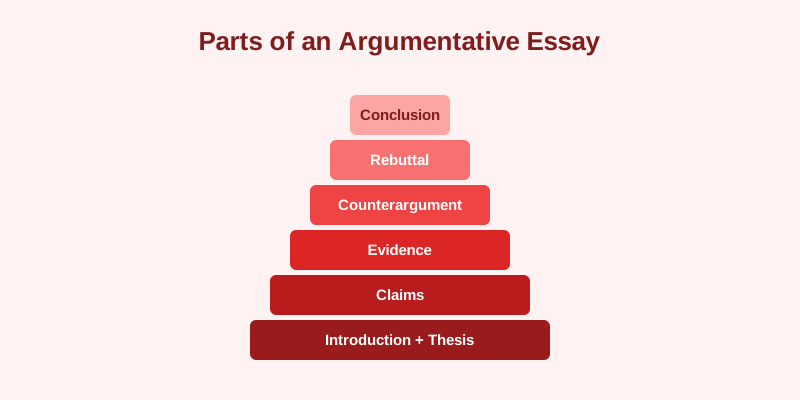
An argumentative essay is like a well-built case in a courtroom. It states a position, presents reasons, backs those reasons with evidence, takes the other side seriously, and closes by explaining why the verdict matters. If any part is missing, the whole argument becomes easier to knock down.
So what are the parts of an argumentative essay? Most teachers and writing guides describe the same core building blocks, even if they use slightly different names. This guide explains all seven, shows what each one looks like using a single running example, and points out the most common mistakes.
The 7 Parts at a Glance
| Part | Where it appears | Its job |
|---|---|---|
| 1. Introduction (hook + background) | Opening paragraph | Engage the reader and explain the issue |
| 2. Thesis statement | End of introduction | State your position clearly |
| 3. Claims (reasons) | Topic sentences of body paragraphs | Give the reasons your position is right |
| 4. Evidence | Body paragraphs | Prove each claim with facts, data, or examples |
| 5. Counterargument | Its own paragraph or within the body | Present the strongest opposing view fairly |
| 6. Rebuttal | Directly after the counterargument | Explain why your position still holds |
| 7. Conclusion | Final paragraph | Reinforce the position and its significance |
Throughout this guide we’ll use one example topic: Should cities make public buses free to ride?
Part 1: The Introduction
The introduction has two sub-parts: a hook that draws the reader in and background that gives them enough context to understand the debate.
Sample:
Every weekday, thousands of commuters in a typical city wait at bus stops with exact change or a transit card in hand. A growing number of cities around the world have asked a simple question: what happens if riders don’t have to pay at all?
Purpose: to make the reader care and to define the issue before you take a side.
Common mistake: spending too long on background. In a five-paragraph essay, the introduction should usually be one paragraph. See our guide on how to write an essay introduction for seven types of hooks.
Part 2: The Thesis Statement
The thesis is the single most important sentence in the essay. It states your position and often previews your main reasons.
Sample:
Cities should make public buses free because doing so increases access to jobs and services, reduces traffic congestion, and costs less than many cities spend on collecting fares.
Purpose: to tell the reader exactly what you will prove.
Common mistakes: stating a fact instead of a position, asking a question, or sitting on the fence (“There are pros and cons to free buses”). An argumentative thesis must take a side that a reasonable person could disagree with. For a deeper look at what separates average and excellent theses, read what makes a great thesis statement.
Note on the last reason: a claim like “costs less than collecting fares” is only usable if your research supports it for the city you’re discussing. Never put a reason in your thesis that you can’t back up with evidence.
Part 3: Claims (Your Reasons)
Each claim is a reason that supports your thesis. Claims usually appear as the topic sentence of each body paragraph.
Sample claim:
Free buses make it easier for low-income residents to reach jobs, schools, and medical appointments.
Purpose: to break your position into separate, provable pieces.
Tips:
- Each body paragraph should focus on one claim.
- Claims should be distinct. If two claims overlap, merge them.
- Three claims are typical for a short essay, but the right number depends on the assignment’s length.
Part 4: Evidence
Evidence is the proof behind each claim. Strong argumentative essays use a mix of types:
- Statistics and data from credible sources (government agencies, research studies, reputable organizations).
- Expert testimony, quoted or paraphrased, from people qualified to speak on the issue.
- Examples and case studies, such as a specific city that tried a policy.
- Logical reasoning that connects causes and effects.
But evidence alone is not enough. Every piece of evidence needs analysis: one or two sentences explaining how it proves your claim. Many essays lose points because they drop a quotation into a paragraph and move on.
Sample evidence + analysis structure:
[Evidence: a statistic from a transit agency or study showing ridership changes after fares were removed.] This increase suggests that cost was a real barrier for many riders, not just an inconvenience, which means removing it allows more residents to reach the places they need to go.
Common mistakes: using unreliable sources, citing evidence that doesn’t match the claim, and forgetting to cite. Our guide to citing sources in MLA and APA covers the basics.
The Warrant: The Hidden Part
Some teachers, especially those who use the Toulmin model, include an eighth element called the warrant: the underlying assumption that connects evidence to a claim. In our example, the warrant is something like “If cost prevents people from riding, removing the cost will increase access.” You don’t always need to state the warrant, but if a reader might not accept it, explain it. Our argumentative essay guide explains the full Toulmin model.
Part 5: The Counterargument
The counterargument (also called the opposing view or concession) presents the strongest reasonable objection to your thesis.
Sample:
Critics argue that free buses could strain city budgets, since fare revenue helps pay for drivers, maintenance, and new vehicles. If that money disappears, service quality might suffer.
Purpose: to show you understand the debate and to make your argument more credible. Readers trust writers who take the other side seriously.
Common mistakes:
- The straw man: presenting a weak or exaggerated version of the opposing view so it’s easy to defeat.
- Skipping it entirely. Without a counterargument, an essay often reads as one-sided persuasion.
- Conceding too much and accidentally undermining your thesis.
Part 6: The Rebuttal
The rebuttal responds to the counterargument. It explains why your position still holds, either because the objection is wrong, less significant than it seems, or solvable.
Sample:
This concern is serious, but it can be addressed. In some systems, fares cover only part of operating costs, and collecting them requires spending on fare machines, enforcement, and processing. Cities can also fund transit through other sources. The question is not whether free buses cost money, but whether the benefits justify the investment.
Purpose: to defend your thesis directly against its strongest challenge.
Types of rebuttal:
- Refute: show the objection is factually incorrect.
- Minimize: acknowledge it but show it matters less than your reasons.
- Solve: show how the problem can be managed.
Tip: like the evidence in your claims, a rebuttal needs support. In a real essay, the sentence about fare collection costs should be backed by a source specific to the transit systems you discuss.
Part 7: The Conclusion
The conclusion reinforces your position and explains why it matters. It should not simply repeat the introduction.
Sample:
Free public buses are not a magic solution to every urban problem, but they remove a barrier that keeps many residents from fully participating in city life. When cities decide how to spend transportation money, they should consider not just what a free system costs but what an inaccessible one costs the people who can’t afford to ride.
Purpose: to leave the reader with the significance of your argument and, when appropriate, a call to action.
Common mistakes: introducing new evidence, ending with “In conclusion, I have proven,” or summarizing each paragraph in order. Our guide on how to write a conclusion shows how to synthesize rather than summarize.
How the Parts Fit Together: A Typical Structure
Paragraph 1: Introduction (hook, background, thesis)
Paragraph 2: Claim 1 + evidence + analysis
Paragraph 3: Claim 2 + evidence + analysis
Paragraph 4: Claim 3 + evidence + analysis
Paragraph 5: Counterargument + rebuttal
Paragraph 6: Conclusion
Some writers place the counterargument right after the introduction, then spend the body proving it wrong. Others address a counterargument inside each body paragraph. All three approaches are valid; choose the one that best fits your argument and your instructor’s expectations. To plan your structure before drafting, use our essay outline templates.
Argumentative vs. Persuasive: Do the Parts Differ?
The two essay types share many parts, but argumentative essays rely more heavily on evidence, logic, and a fair counterargument, while persuasive essays may lean more on emotional appeals and the writer’s voice. If your assignment says “argumentative,” make sure parts 4, 5, and 6 are strong. Compare the approaches in our persuasive essay guide.
Parts of an Argumentative Essay Checklist
- Does the introduction hook the reader and explain the issue?
- Does the thesis take a clear, debatable position?
- Does each body paragraph open with one distinct claim?
- Is every claim supported by credible, cited evidence?
- Does every piece of evidence have analysis?
- Is the counterargument the strongest version of the opposing view?
- Does the rebuttal directly respond to it?
- Does the conclusion explain why the argument matters?
Practice Exercise
Choose a debatable question (for example, “Should schools replace letter grades with written feedback?”). On one page, write a single sentence for each of the seven parts: one hook, one thesis, three claims, one counterargument, one rebuttal, and one concluding sentence. If any part is hard to write, that’s where your argument needs more thinking or research before you start drafting.
Frequently Asked Questions
What are the 5 parts of an argumentative essay?
What is the difference between a claim and a thesis?
Where does the counterargument go in an argumentative essay?
Does an argumentative essay need a counterargument?
Keep Learning
How to Do a Literacy Essay: Write a Literacy Narrative Readers Connect With
A step-by-step guide to writing a literacy essay (literacy narrative): choosing a meaningful moment, structuring your story, reflecting on what it means, plus an original example and topic ideas.
Essay WritingWhat Is a Great Thesis Statement? 7 Tests That Separate Good From Great
What makes a thesis statement great, not just correct? Use seven simple tests to evaluate and upgrade your thesis, with before-and-after examples showing how average claims become memorable ones.
Essay WritingHow Do You Write an Essay Outline? A 5-Step Method With Templates
Learn how to write an essay outline in five steps, with free templates for five-paragraph, argumentative, and compare-and-contrast essays, plus a filled-in example and tips for turning your outline into a draft.