What Is an Extemporaneous Speech? How to Prepare and Deliver One From Notes
Learn what an extemporaneous speech is, how it differs from impromptu and manuscript speaking, and how to prepare one step by step: from a full outline to key-word speaking notes, with a sample note card and practice plan.
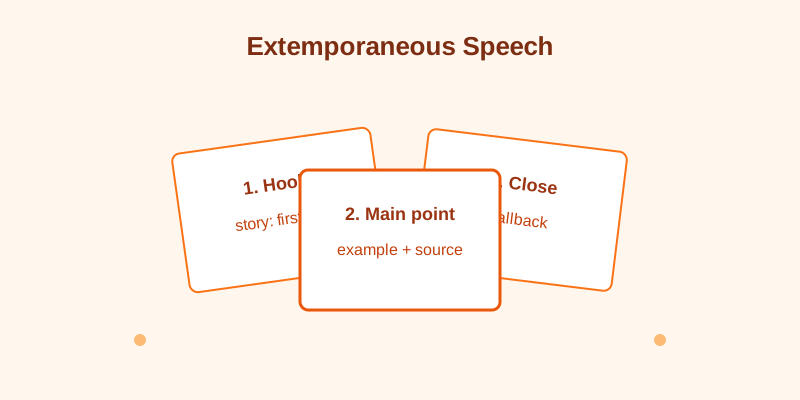
The word sounds complicated, but you’ve probably heard plenty of extemporaneous speeches. A teacher explaining a lesson without reading from a page. A colleague walking through a project update with a few notes in hand. A student presenting research while glancing at index cards. All of them prepared carefully, but none of them read a script.
That’s the extemporaneous method, and many instructors and experienced speakers consider it the most effective way to deliver most speeches. This guide explains what an extemporaneous speech is, how it compares to other methods, and how to prepare one step by step.
What Is an Extemporaneous Speech?
An extemporaneous speech is a speech that is fully prepared and rehearsed, but delivered from brief notes instead of a word-for-word script.
You know your structure, your main points, your evidence, and your examples. What you don’t fix in advance is the exact wording of every sentence. Each time you practice, the language changes a little, but the content stays the same.
The result is a speech that feels natural and conversational while still being organized and well supported.
Extemporaneous vs. Other Delivery Methods
| Method | Preparation | Delivered from | Sounds |
|---|---|---|---|
| Extemporaneous | Full | Key-word notes | Conversational and organized |
| Manuscript | Full | Complete script | Precise, but can sound read |
| Memorized | Full | Memory | Polished, but can sound recited |
| Impromptu | Little or none | Nothing | Spontaneous, less depth |
The most common confusion is between extemporaneous and impromptu. Both can sound spontaneous, but an extemporaneous speech is planned in advance and an impromptu one is not. For a full comparison of planned methods, read what is a prepared speech. If you’re speaking without preparation, see how to give an impromptu speech.
Why Use the Extemporaneous Method?
- Natural delivery. You talk to the audience instead of reading at them.
- Better eye contact. You only glance at short notes.
- Flexibility. You can adjust if the audience looks confused, if time runs short, or if someone asks a question.
- Less memorization stress. If you forget a phrase, you simply say it another way.
- Deeper understanding. You have to know your material, not just the words.
The trade-off is that you need to prepare thoroughly. Without enough practice, extemporaneous speakers can ramble or lose their place.
How to Prepare an Extemporaneous Speech: 6 Steps
Step 1: Plan Your Purpose and Main Points
Identify your general purpose (inform, persuade, or entertain), your specific purpose, and your central idea. Then choose two to four main points. If your topic feels too big, narrow it first with our guide on how to narrow down speech topics.
Step 2: Write a Full Preparation Outline
A preparation outline is a detailed outline in full sentences. It includes:
- Your introduction (attention-getter, central idea, preview).
- Each main point as a full-sentence claim.
- Supporting material under each point: examples, statistics, quotations, and their sources.
- Transitions between points.
- Your conclusion (summary and memorable close).
This outline is where your thinking happens. Our guide to writing a speech includes a sample outline you can adapt.
Step 3: Practice From the Full Outline
Talk through your speech aloud using the full outline two or three times. Don’t read it; explain it. You’ll notice that your wording changes each time. That’s normal and expected.
Step 4: Create Key-Word Speaking Notes
Now condense your outline into speaking notes: short reminders of each section. Good speaking notes include:
- Key words or short phrases for each point, not sentences.
- Your first and last lines written in full, so you start and finish confidently.
- Exact quotations, statistics, and source names written out, so you cite them accurately.
- Transitions, briefly noted.
- Delivery cues such as “slow down,” “pause,” or “show slide.”
Sample note card (Main Point 2):
MAIN POINT 2: Volunteering builds job skills

- Shelter example: scheduling 12 volunteers
- Skills: teamwork, communication, problem-solving
- Source: [name, year] — write exact stat here
- PAUSE
→ Transition: "Skills matter, but so do people..."
Use large, clear writing or print, and number your cards.
Step 5: Rehearse From Your Speaking Notes
Practice the full speech several times using only your speaking notes:
- Stand up and speak at full volume.
- Time every run and adjust if you’re over or under.
- Practice looking up for most of each sentence, glancing down only between ideas.
- Record yourself at least once.
- Spread practice over several days. Short sessions over time are usually more effective than one long session.
If you find yourself repeatedly stuck at the same point, add a word to your notes there. If you never look at a note, you can remove it.
Step 6: Deliver Conversationally
On the day:
- Begin with your first line, which you know by heart, and make eye contact.
- Treat the speech like a structured conversation.
- Use your notes as a map, not a script.
- If you lose your train of thought, pause, glance at your card, and continue. The audience won’t know which words you planned.
- Use vocal variety to emphasize key points. See our guide to modulation in speech.
Extemporaneous Speaking in Speech and Debate
In competitive speech and debate, “extemp” often refers to a specific event: competitors draw a question, usually about current events, prepare for a limited time, and deliver a short analytical speech. Preparation time, speaking time, and rules vary by league and tournament, so always check the rules you’re competing under.
The core skills are the same: a clear thesis, two or three organized points, credible evidence, and confident, conversational delivery.
Common Extemporaneous Speech Mistakes
- Writing too much on your notes. If your cards contain full paragraphs, you’ll end up reading.
- Not practicing enough. Extemporaneous delivery only sounds effortless after rehearsal.
- Practicing silently. Thinking through your speech isn’t the same as saying it.
- Rambling. Without a firm outline, speakers can drift. Stick to your main points.
- Forgetting sources. Write citations on your cards so you state them accurately.
- Ignoring the time limit. Time every practice run.
Extemporaneous Speech Checklist
- Have I written a full preparation outline?
- Have I practiced from the full outline aloud?
- Are my speaking notes limited to key words and short phrases?
- Are my opening and closing lines written in full?
- Are quotations, statistics, and sources written exactly?
- Have I rehearsed from my notes several times and timed myself?
- Are my cards numbered and easy to read?
Practice Exercise
Choose a topic you know well, such as a hobby, a favorite place, or a skill you’ve learned. Write a one-sentence central idea and three main points. Put each main point on a single index card using no more than ten words. Give the speech aloud three times from the cards and record the third attempt. Listen for moments where you sounded most natural, and note which cards helped and which you didn’t need. For more delivery advice, see our 10 public speaking tips.
Frequently Asked Questions
What is an extemporaneous speech?
What is the difference between extemporaneous and impromptu speeches?
How many note cards should I use for an extemporaneous speech?
What is extemp in speech and debate?
Keep Learning
What Is a Memorized Speech? How to Memorize a Speech Without Sounding Robotic
Learn what a memorized speech is, when to use one, and seven proven techniques to memorize a speech quickly, from learning the structure first to chunking and the memory palace, plus what to do if you forget a line.
Speech DeliveryWhat Is Modulation in Speech? 5 Elements of Vocal Variety (With Exercises)
Learn what voice modulation in speech means, why it matters, and how to use its five elements: pitch, pace, volume, tone, and pauses. Includes marked examples and practice exercises to stop sounding monotone.
Speech DeliveryHow to Overcome Stage Fright: A Practical Plan for Nervous Speakers
Understand why stage fright happens and use a step-by-step plan, from preparation weeks ahead to the first thirty seconds on stage, to speak with more confidence.