 Javed Ali • • 7 min read • Speech Delivery
Body Language in Public Speaking: Posture, Gestures, Eye Contact, and Movement
Learn how to use body language in public speaking to look confident and connect with your audience. Covers posture, eye contact, hand gestures, facial expressions, and movement, with practice drills and a checklist.
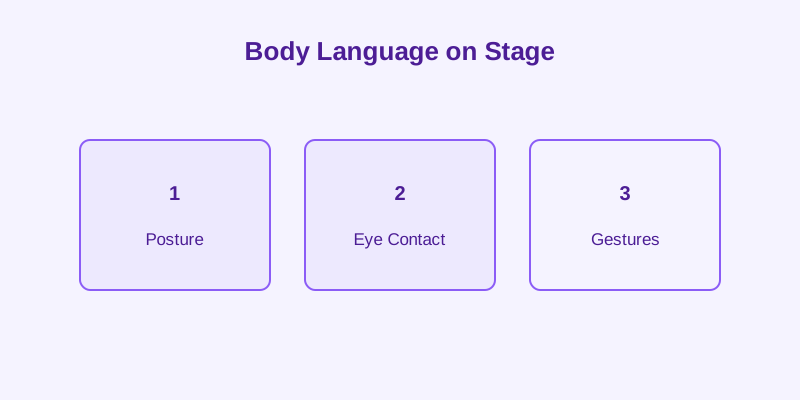
Before you say a single word, your audience has already started forming an impression. They notice how you walk to the front, how you stand, and where you look. Throughout your speech, your body keeps sending signals: confident or nervous, engaged or distant, sincere or rehearsed.
The goal isn’t to perform a set of “power poses.” It’s to make your body support your message instead of distracting from it. This guide covers the five areas that matter most and gives you drills to practice each one.
How Much Does Body Language Really Matter?
You may have heard that “93% of communication is nonverbal.” That’s a myth. The figure comes from a pair of 1960s experiments by psychologist Albert Mehrabian, which studied how people judged a speaker’s feelings when single words conflicted with tone of voice and facial expression. Mehrabian has stated that the finding doesn’t apply to communication in general.
What his work does suggest is useful: when your body and your words don’t match, people tend to believe your body. If you say “I’m excited to be here” while staring at the floor, the audience hears nervousness, not excitement. Good body language is about alignment, so your audience gets one consistent message.
1. Posture: Your Foundation
Good posture makes you look confident and helps you breathe and project your voice.
How to stand:
- Feet about shoulder-width apart, weight balanced evenly on both
- Knees soft, not locked (locked knees make you stiff and can affect circulation)
- Shoulders relaxed and slightly back, chest open
- Head level, chin parallel to the floor
Avoid:
- Shifting weight from foot to foot or swaying
- Leaning on the lectern or one hip
- Crossing your legs while standing
- Hunching forward over your notes
Drill: the reset. Before you speak and whenever you feel tense, plant your feet, take one slow breath, and let your shoulders drop. This takes three seconds and resets both your posture and your nerves. Our guide on how to overcome stage fright has more techniques for staying calm.
2. Eye Contact: Your Connection
Eye contact is the most powerful tool for making an audience feel included. It also helps you read their reactions and adjust.
The one-thought rule: Look at one person for one complete thought, about three to five seconds, then move to someone else. Darting from face to face every second looks nervous; staring at one person for too long feels uncomfortable for them.
For large audiences: Divide the room into sections (front left, back center, and so on). Move between sections in an unpredictable pattern, and in each section pick one person to speak to. People sitting near that person will feel you’re speaking to them too.
Common mistakes:
- Looking at the ceiling, the back wall, or the floor
- Talking to your slides or notes
- Favoring one side of the room
- Only looking at the teacher, judge, or most important person
If eye contact makes you nervous: start with friendly faces, the people nodding or smiling, and gradually widen your circle. Looking at the space between someone’s eyes, or at their forehead, also works from a distance.
Drill: the sentence hold. Place a few stuffed toys or sticky notes around a room. Practice your speech, finishing an entire sentence while looking at one “person” before moving to the next.
3. Gestures: Your Emphasis
Natural gestures help you explain ideas, show emphasis, and release nervous energy. The problem is rarely gesturing too much; it’s gesturing without purpose or not gesturing at all.
Home base: When you’re not gesturing, rest your hands loosely at your sides or lightly together at about waist height. Return here between gestures.
The gesture zone: Keep most gestures between your waist and shoulders, and slightly away from your body. Gestures that stay tight against your chest look timid; gestures above the head are usually too big for a classroom.
Purposeful gestures to try:
| Gesture | Use it for |
|---|---|
| Counting on fingers | Listing points (“There are three reasons…”) |
| Hands spread apart | Size, scale, or inclusion (“all of us”) |
| Palms up, open | Offering, inviting, or asking a question |
| Hand moving left to right | Time or sequence (from the audience’s view) |
| Hands coming together | Connection or agreement |
Avoid distracting habits:
- Hands in pockets, clasped behind your back, or arms crossed
- Clicking pens, playing with rings or hair, adjusting clothes
- Repeating the same gesture over and over
- Pointing directly at audience members
Match gestures to the room. In a small room, keep gestures modest. On a large stage, make them bigger and hold them slightly longer so the back rows can see.
4. Facial Expressions: Your Emotion
Your face tells the audience how to feel about what you’re saying. A serious story told with a blank face feels cold; an exciting idea delivered with a frown feels confusing.
- Smile at the start. A genuine smile before your first line relaxes both you and the audience.
- Let your expression follow your content. Serious points get a serious face; light moments get a smile. Practice your speech with the emotion of each section in mind.
- Watch your “thinking face.” Many speakers frown or squint while concentrating. Record yourself to see if you do.
- Avoid a frozen smile. Smiling through bad news or a serious point undermines your credibility.
Facial expression and voice work together. When you feel the emotion of a sentence, both your face and your vocal modulation tend to follow.
5. Movement: Your Structure
Movement can make you look confident and help your audience follow your structure. It can also be a major distraction if it’s aimless.
Move with purpose:
- Move on transitions. Take a few steps to a new spot as you move to your next main point, then stop and plant your feet to deliver it. This visually signals that a new section has started.
- Move toward the audience for an important or personal moment.
- Stand still for key lines. Your most important sentences, especially your thesis and final line, land best when you’re not moving.
Avoid:
- Pacing back and forth without purpose
- Walking backward away from the audience
- Turning your back to read slides
- Hiding behind the lectern for the entire speech, if you’re allowed to move
If you must stay at a lectern, you can still use posture, gestures, and eye contact. Step slightly to the side of it, if possible, for your opening and closing.
Body Language for Different Speech Types
- Impromptu speeches: You don’t have time to plan gestures, so focus on posture and eye contact. Pause and plant your feet before you begin. See our guide on how to give an impromptu speech.
- Manuscript speeches: Look up at the end of each sentence and for key phrases. See how to write a manuscript speech.
- Memorized speeches: Without notes, your hands are free. Plan a few gestures for key moments, but keep the rest natural. See how to memorize a speech.
- Online presentations: Look at the camera, not the screen, for “eye contact.” Sit up straight, keep your face well lit and centered, and keep gestures within the frame.
How to Practice Body Language
- Record yourself. Watch the video once with the sound off, focusing only on your body. Note any repeated habits.
- Practice standing up, in the same position you’ll use for the real speech.
- Mark your script with notes such as “[step forward],” “[count on fingers],” or “[pause, eye contact]” at key moments.
- Fix one habit at a time. Trying to fix everything at once leads to stiff, robotic delivery.
- Practice in front of a friend and ask them to note one thing that helped and one thing that distracted.
For more delivery advice, see our collection of public speaking tips.
Body Language Checklist
- Do I stand with balanced weight, relaxed shoulders, and soft knees?
- Do I hold eye contact for a full thought before moving on?
- Do I include every section of the room?
- Do I have a relaxed “home base” for my hands?
- Are my gestures purposeful and within the gesture zone?
- Does my facial expression match my content?
- Do I move with purpose, mainly on transitions?
- Do I stand still for my most important lines?
- Have I watched a recording of myself with the sound off?
Practice Exercise
Choose a one-minute section of a speech you’re preparing. Deliver it three times, recording each version. In the first, focus only on posture and eye contact. In the second, add two planned gestures at key moments. In the third, add one purposeful movement at a transition and stand completely still for your final line. Watch all three with the sound off and ask a friend which version looked most confident, and why.
Frequently Asked Questions
Why is body language important in public speaking?
What should I do with my hands when giving a speech?
How do I make eye contact with a large audience?
Is it true that 93% of communication is nonverbal?
Keep Learning
What Is a Memorized Speech? How to Memorize a Speech Without Sounding Robotic
Learn what a memorized speech is, when to use one, and seven proven techniques to memorize a speech quickly, from learning the structure first to chunking and the memory palace, plus what to do if you forget a line.
Speech DeliveryWhat Is an Extemporaneous Speech? How to Prepare and Deliver One From Notes
Learn what an extemporaneous speech is, how it differs from impromptu and manuscript speaking, and how to prepare one step by step: from a full outline to key-word speaking notes, with a sample note card and practice plan.
Speech DeliveryWhat Is Modulation in Speech? 5 Elements of Vocal Variety (With Exercises)
Learn what voice modulation in speech means, why it matters, and how to use its five elements: pitch, pace, volume, tone, and pauses. Includes marked examples and practice exercises to stop sounding monotone.